Aerosol Manufacturing Under White Label or Private Label

Aerosol manufacturing under white label or private label has established itself as one of the most profitable and efficient strategies for companies looking to launch their own products without taking on the complexity of industrial production. In Spain, a market that produces approximately 370 million aerosol units annually, the demand for custom manufacturing services is experiencing steady growth driven by distributors, retail chains, and emerging brands.
Exclusive formulation represents the differential value that allows brands to stand out in a saturated market. Through specialized research and development processes, aerosol manufacturers like Ilerspray offer tailor-made solutions that combine chemical innovation, cutting-edge technology, and rigorous regulatory compliance.
What is White Label Aerosol Manufacturing?
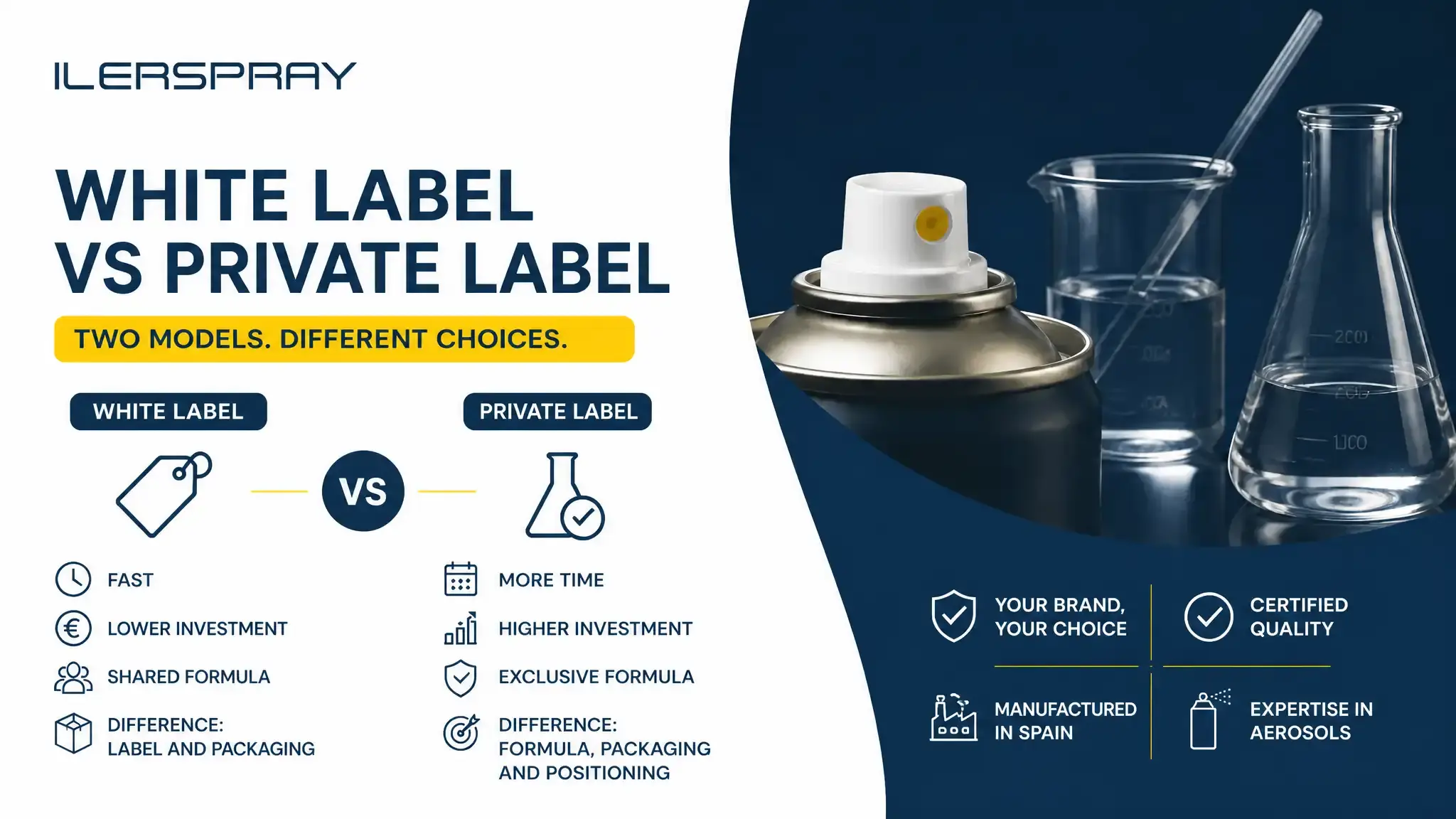
Manufacturing under white label or private label consists of the production of aerosols by a specialized manufacturer that the client subsequently markets with their own brand and identity. This model, also known as maquila or contract filling, allows companies to access high-quality products without the need to invest in infrastructure, machinery, or specialized personnel.
According to data from the Spanish Aerosol Association (AEDA), the Spanish aerosol sector represents 5.8% of European production, positioning itself as the fourth largest manufacturer on the continent. This robust ecosystem offers brands exceptional opportunities to develop personalized products with a guarantee of quality and full traceability.
Advantages of Outsourcing Aerosol Manufacturing
Collaborating with a specialized manufacturer provides multiple strategic and operational benefits:
Drastic reduction of initial costs: Avoiding investment in production plants, automated filling lines, and equipped laboratories can lead to savings of hundreds of thousands of euros. According to industry experts, the cost of establishing an in-house production line can easily exceed one million euros, while outsourcing allows access to state-of-the-art technology by paying only for the units produced.
Access to specialized technical expertise: Manufacturers with decades of experience, such as those operating in the industrial estates of Lleida or Barcelona, have teams of chemical engineers and specialized technicians who guarantee optimized, stable, and safe formulas.
Productive flexibility without compromises: The ability to adjust production volumes according to market demand eliminates risks associated with overstocking or shortages. Spanish manufacturers offer everything from pilot batches of 5,000 units to mass productions exceeding one million aerosols annually.
Guaranteed regulatory compliance: European legislation on aerosols is complex and demanding. Working with manufacturers certified under ISO 9001:2015 and ISO 22716:2017 standards ensures that products meet all safety, labeling, and technical documentation requirements.
"Outsourcing manufacturing allows companies to focus on their core business: marketing, sales, and brand development, while we handle the technical and regulatory complexity" - Specialized aerosol manufacturer
Exclusive Formulation: The Heart of Differentiation
Exclusive formulation is the process by which a unique chemical composition adapted to the specific needs of each brand is developed. This service goes far beyond simple production: it involves research, development, stability testing, and performance optimization.
Development of custom formulas: Specialized laboratories work with hundreds of active ingredients, solvents, fragrances, and propellants to create products that meet exact specifications. From air fresheners with exclusive olfactory notes to industrial lubricants with specific technical properties, the possibilities are virtually limitless.
Innovation in ingredients: The trend toward sustainability has driven the development of formulations with biodegradable ingredients, eco-friendly propellants such as compressed air or nitrogen, and the absence of harmful chemicals. According to the European Aerosol Federation, more than 60% of new developments incorporate eco-efficiency criteria.
Stability and performance testing: Each exclusive formulation must pass rigorous controls including thermal stability tests, packaging compatibility, product efficacy, and shelf life. These processes can take between 3 and 8 weeks depending on the complexity.
"Formulation is where the true competitive advantage lies. We have seen brake cleaners where our product actually removes dirt, while the competition only uses pressurized gas" - Aerosol development expert
Complete Manufacturing Process: From Idea to Final Product
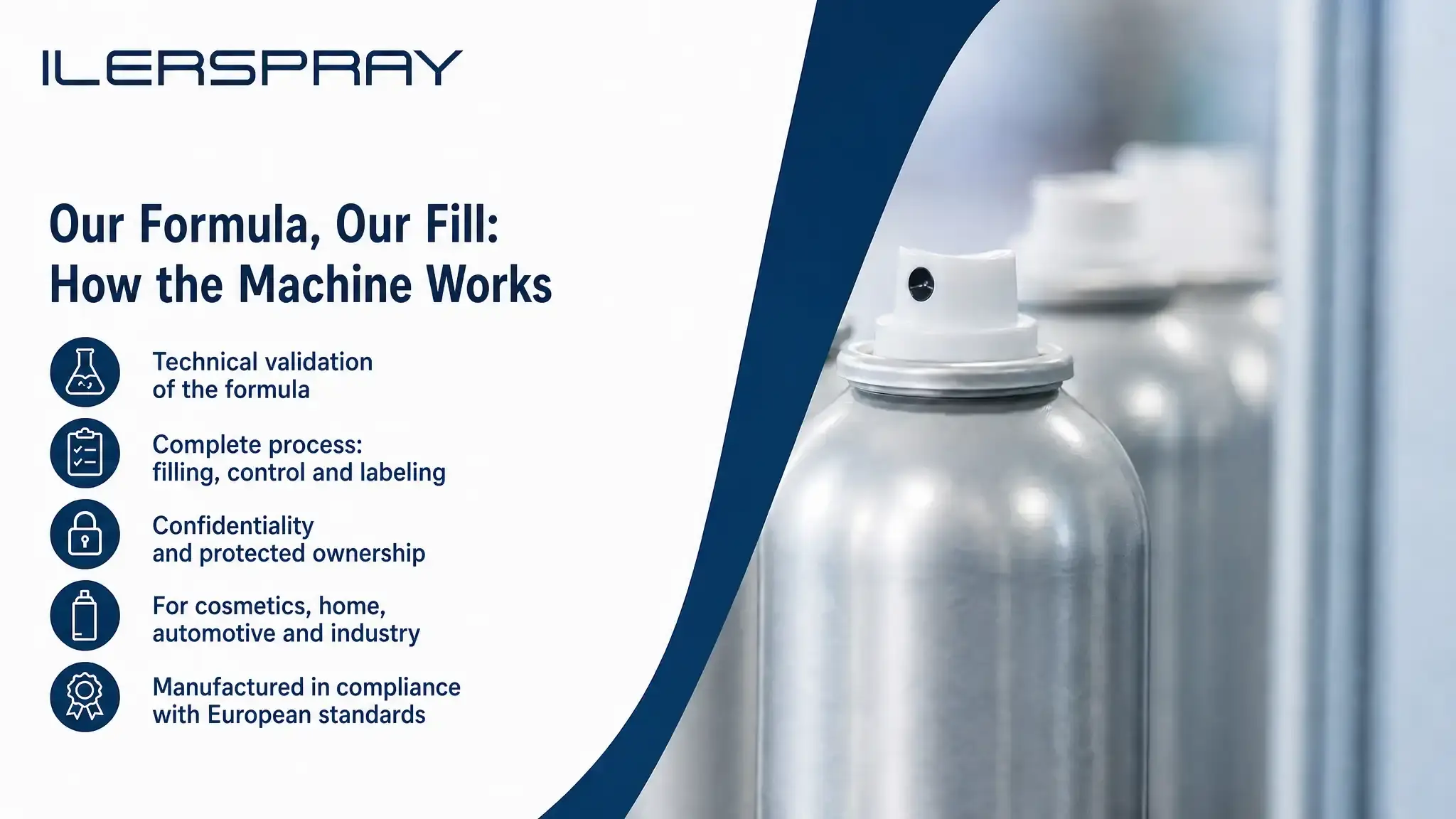
The aerosol manufacturing process under white label follows a structured methodology that guarantees quality and traceability:
- Phase 1: Development and formulation - This initial stage involves meetings with the client to understand their needs, business objectives, and technical specifications. The R&D team develops formulation proposals, selects ingredients, and creates prototypes for evaluation.
- Phase 2: Selection of packaging and components - Aerosols can be packaged in aluminum cans (representing 35% of the Spanish market) or tinplate (65%). The choice depends on factors such as chemical compatibility, brand image, and resistance requirements. Valves, actuators, and spray systems are selected to ensure optimal dispensing.
- Phase 3: Production and filling - In high-speed automated lines, the base product is introduced into the container, the valve is installed and hermetically sealed, and the propellant is injected under controlled pressure and temperature conditions. Modern systems use mass measurement to dose exactly the required amount of gas.
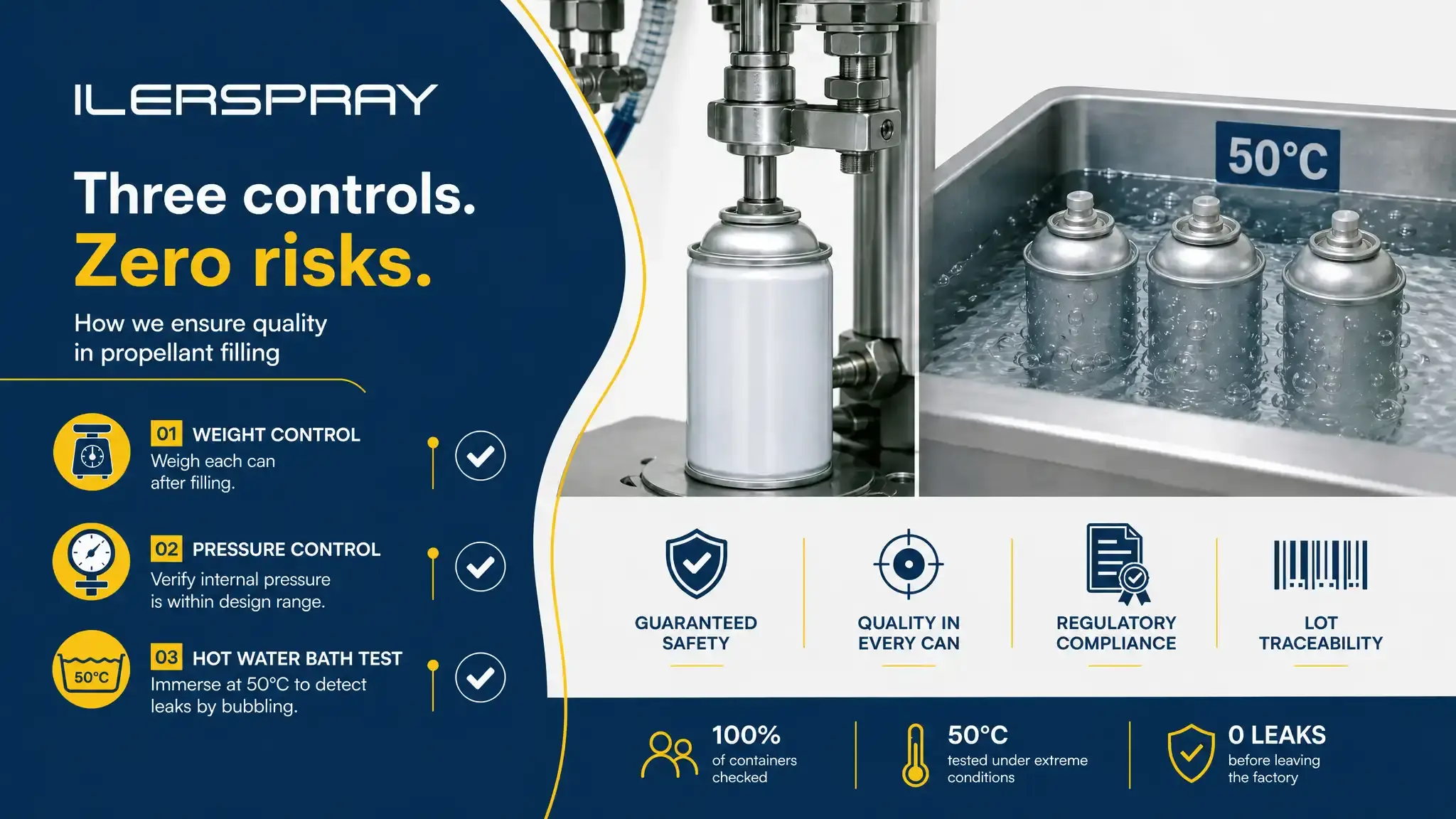
- Phase 4: Comprehensive quality control - Each aerosol undergoes leak testing using ultrasonic detectors or immersion in a 50°C hot water bath. Weight, internal pressure, and valve system operation are verified. Defective units are automatically rejected.
- Phase 5: Labeling and custom packaging - Label design, application of batch codes, manufacturing and expiration dates, and final packaging are carried out according to client specifications, creating a product ready for commercialization.
Sectors and Applications of White Label Aerosols
The versatility of aerosols allows their application in multiple sectors:
Home and cleaning (30% of the market): Air fresheners, multi-purpose cleaners, insecticides, kitchen and bathroom products. This segment experiences constant innovation with long-lasting fragrances and antibacterial formulations.
Personal care and cosmetics (40% of the market): Deodorants, hairsprays, shaving foams, spray sunscreens, dry shampoos. The aerosol format guarantees hygienic, uniform, and controlled application, aspects highly valued by consumers.
Automotive and maintenance (20% of the market): Brake cleaners, lubricants, degreasers, tire polishers, anti-fog products. Demand in this segment is growing driven by the culture of vehicle care and preventive maintenance.
Industrial and professional (10% of the market): Release agents, leak detectors, specialized lubricants, spray paints, high-temperature products. These technical aerosols require highly specialized formulations and specific certifications.
How Much Does It Cost to Manufacture White Label Aerosols?
Manufacturing costs vary significantly depending on multiple factors. Although manufacturers do not publish standard rates due to the customization of each project, it is possible to establish indicative ranges:
Exclusive formulation development: Between €1,500 and €5,000 depending on chemical complexity, development time, and the number of iterations required. Some companies offer catalogs of predefined formulas that can be adapted, reducing these costs to €500-€1,000.
Production costs per unit: For runs of 10,000 units, the cost per aerosol ranges between €0.80 and €2.50 depending on format, formula, and type of packaging. Larger volumes allow for significant economies of scale: productions exceeding 50,000 units can reduce the unit cost by up to 30-40%.
Packaging design and labeling: The development of brand image, graphic design, and preparation of final artwork can range between €500 and €3,000 for standard projects. Premium services that include market research and packaging strategy can exceed €5,000.
Certifications and documentation: The preparation of technical sheets, safety data sheets, stability reports, and documentation for health registration can represent between €300 and €1,500 per reference.
Criteria for Selecting an Aerosol Manufacturer
Choosing the right industrial partner is decisive for the success of the project:
- Demonstrable experience in the sector: Look for manufacturers with a track record of more than 10-15 years and a diversified client portfolio. Accumulated experience translates into the ability to solve technical problems and anticipate regulatory challenges.
- Production capacity and flexibility: Verify that the facilities can handle everything from small batches to large volumes without compromising deadlines. Manufacturers with multiple production lines offer greater adaptability.
- Current quality certifications: Demand ISO 9001 (quality management), ISO 22716 (good manufacturing practices for cosmetics) and, depending on the sector, specific certifications such as BRC or IFS for consumer products.
- Strategic location: Proximity to ports and logistics centers reduces transport costs. Manufacturers located in areas like Lleida, Barcelona, or Valencia offer logistical advantages for European and Mediterranean export.
- 360º comprehensive services: Prioritize manufacturers that offer everything from formulation to logistics, including design, legal, and marketing. Comprehensive services simplify management and reduce time to market.
- Commitment to sustainability: More and more consumers value ecological products. Working with manufacturers that use green propellants, recyclable packaging, and biodegradable formulations provides a competitive advantage.
Innovations and Trends in Aerosol Formulation
The aerosol sector is constantly evolving, incorporating disruptive technologies:
Bag-on-Valve (BOV) systems: This technology separates the product from the propellant using an inner bag, allowing the use of compressed air as a propellant. It offers advantages such as dispensing at any angle (360°), better product preservation, and greater sustainability.
Smart formulations: Products that change color to indicate effectiveness, aerosols with specific pheromones for pest control, or thermochromic formulations that respond to temperature changes.
Customizable packaging with 3D printing: The ability to create unique packaging designs through additive manufacturing opens up limitless possibilities for premium brands seeking extreme differentiation.
Next-generation propellants: Research into alternatives to hydrocarbons such as HFO-1234ze, a propellant with near-zero global warming potential that meets the strictest regulations.
Connected aerosols (IoT): Although still in the experimental phase, some manufacturers are developing aerosols with sensors that monitor use, remaining quantity, and can communicate with mobile applications.
Success Case: From Concept to Shelf in 12 Weeks
A Spanish distribution chain contacted a specialized manufacturer to develop its own-brand line of air fresheners. The briefing included three exclusive fragrances, 300ml containers with a differentiated design, and a competitive target price.
Weeks 1-3: Development of base formulations, fragrance selection, and olfactory testing with a consumer panel. 12 initial prototypes were created and reduced to 3 finalists.
Weeks 4-6: Packaging design, chemical compatibility testing, labeling development in compliance with regulations, and production of pre-industrial samples for final approval.
Weeks 7-9: Production of the initial batch of 25,000 units per reference, exhaustive quality controls, and preparation of technical and regulatory documentation.
Weeks 10-12: Logistics, distribution to regional centers, and launch in more than 200 stores. The product reached a turnover of 85% in the first 30 days, exceeding forecasts.
This case illustrates how an experienced manufacturer can condense the entire development cycle into less than three months, allowing brands to react quickly to market opportunities.
Legal and Regulatory Aspects in Spain
Aerosol manufacturing in Spain is subject to a rigorous regulatory framework:
Regulation (EC) 1272/2008 (CLP): Classification, labeling, and packaging of substances and mixtures. Aerosols must include hazard pictograms, H-phrases (hazard statements), and P-phrases (precautionary statements) as appropriate.
ADR Regulations: Transport of dangerous goods by road. Aerosols, classified as UN 1950, require specific documentation and authorized vehicles for their transport.
Cosmetic Regulation (EC) 1223/2009: For cosmetic aerosols, notification in the Cosmetic Products Notification Portal (CPNP), safety assessment, and the presence of a responsible person in the EU are required.
Packaging Directive 94/62/EC: Obliges manufacturers to ensure that packaging is recyclable and to comply with extended producer responsibility (EPR) systems.
"Regulatory compliance is not negotiable. Working with manufacturers that integrate compliance into every phase of the process avoids costly subsequent problems and guarantees commercialization without delays" - Regulatory advisor for the chemical sector
Sustainability and Circular Economy in Aerosoles
The aerosol industry has made significant advances in sustainability. Since 1989, European consumer aerosols have not contained CFCs (chlorofluorocarbons), substances that damaged the ozone layer.
100% Recyclability: Aluminum and tinplate containers are 100% recyclable infinitely many times without loss of properties. In Spain, approximately 1 billion aerosols are recycled annually through selective collection systems.
Eco-friendly propellants: Replacing hydrocarbons with compressed air, nitrogen, or CO2 reduces the carbon footprint by up to 60% according to industry studies. The Bag-on-Valve system allows the use of these green propellants while maintaining performance.
Biodegradable ingredients: Modern formulations prioritize surfactants and solvents that decompose naturally in the environment, minimizing impact on aquatic ecosystems.
Reduction at source: Advances in packaging design have allowed for a reduction in the thickness of metal walls by up to 30% in the last decade, maintaining strength while saving material.
Ilerspray: Leader in White Label Manufacturing
Based in Torres de Segre (Lleida), Ilerspray exemplifies excellence in white label aerosol manufacturing. Founded by professionals with more than 25 years of industry experience, the company combines entrepreneurial youth with deep market knowledge.
Differentiating technical capacity: Facilities equipped with automated filling lines, tanks with up to 35,000 liters of capacity, certified R&D laboratories, and clean rooms for products requiring a controlled atmosphere.
Diversified portfolio: From air fresheners and cleaning products to industrial lubricants and aerosol cosmetics. Productive versatility allows serving multiple sectors with homogeneous quality standards.
Established own brands: APP Range (home and cosmetics), Le-Brill Auto (automotive care), and Le-Brill Industry (industrial applications) demonstrate comprehensive product development capability, experience they transfer to white label projects.
Commitment to clients: From pilot batches of 5,000 units to productions of millions of aerosols, Ilerspray adapts its production capacity to the real needs of each client, without penalizing small volumes.
Certifications and quality: ISO 9001:2015, ISO 22716:2017, and the Business Excellence Certification (CIEGE) guarantee controlled processes, full traceability, and compliance with the most demanding standards.
The Future of White Label in Aerosols
The global aerosol market is projected to reach 124.37 billion dollars by 2030, with an annual growth rate of 6.10%. White label will capture a growing portion of this market driven by several factors:
- Democratization of access to technology: Specialized manufacturers are investing in additional production capacity, which reduces barriers to entry and allows small and medium-sized brands to access industrial-quality products.
- Mass customization: Flexible production technologies will allow for the creation of smaller batches of highly personalized products without cost penalties, opening opportunities for specific niches.
- Digital integration: Online platforms connecting brands with manufacturers will simplify the development process, allowing virtual product simulations, digital approvals, and real-time production management.
- Demand for transparency: Consumers will demand detailed information about ingredients, origin, and sustainability. Manufacturers providing blockchain traceability and verifiable certifications will gain a competitive advantage.
Conclusion: White Label as a Growth Strategy
Aerosol manufacturing under white label with exclusive formulation represents an exceptional strategic opportunity for companies seeking differentiation without taking on production risks. In Spain, a mature, experienced, and technologically advanced industrial ecosystem offers comprehensive services ranging from the initial concept to final distribution.
The key to success lies in selecting a manufacturer that is not just a supplier, but a true strategic partner capable of providing value in formulation, design, regulatory compliance, and cost optimization. Companies like Ilerspray, with decades of accumulated experience, state-of-the-art infrastructure, and a commitment to sustainable innovation, exemplify the standard of excellence that brands should seek.
For more information on white label manufacturing services and exclusive formulation development, contact Ilerspray at info@ilerspray.com or visit www.ilerspray.com