White Label Vs. Private Label: What the Difference Means for Your Brand
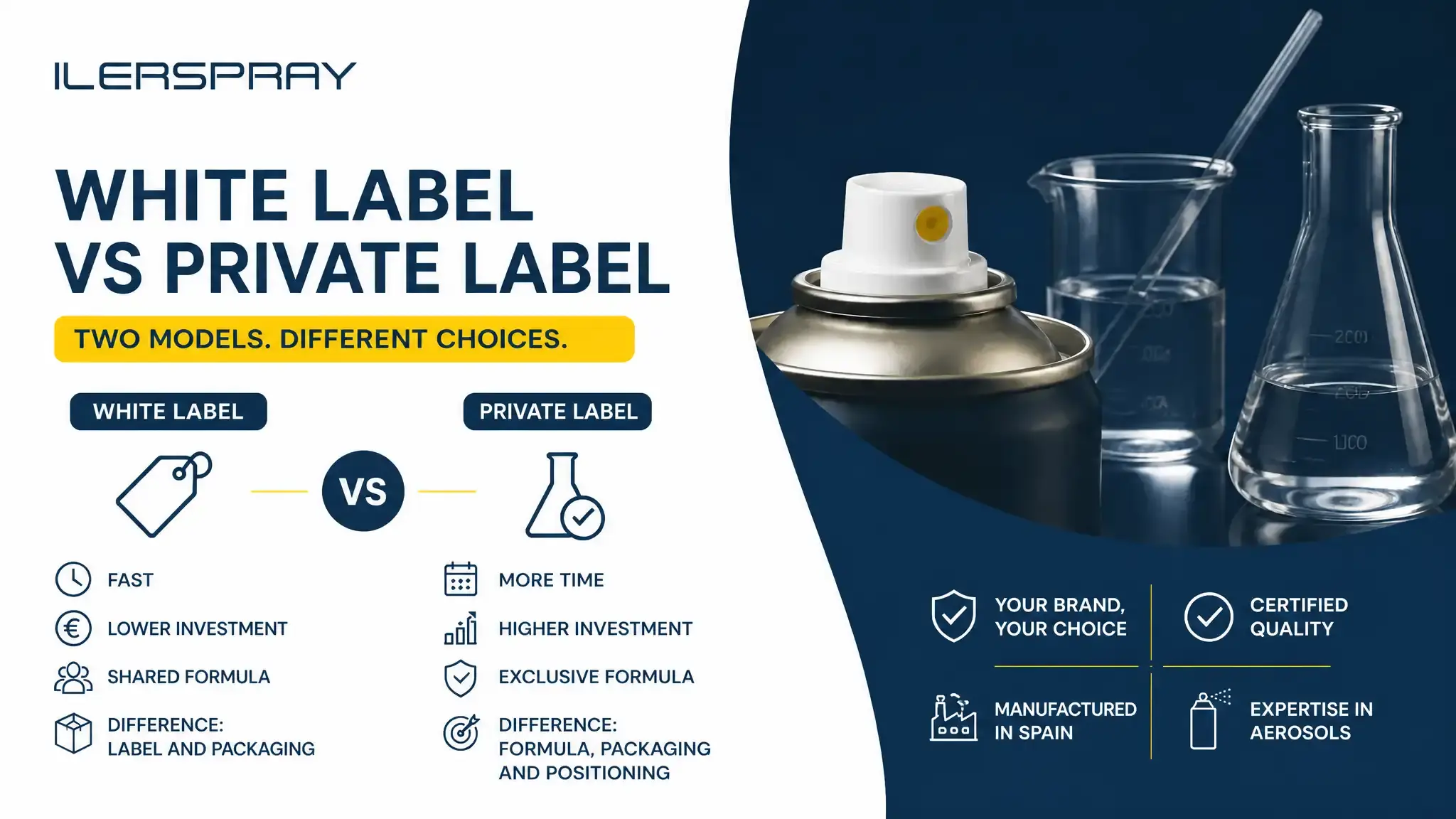
White label means buying a finished, generic formula that the manufacturer already sells to multiple brands, you add your label, nothing more. Private label means co-developing a formulation made exclusively for your brand, one that no competitor can buy off the same shelf. The right choice depends on your timeline, budget, and how distinctly you need to stand out.
The Core Difference between the Two Models
White label starts with a product the manufacturer already produces at scale. Several brands can purchase that same formula, package it under their own name, and sell it as their own. The core product is identical across all resellers, only the label changes. Speed and low entry cost are the main advantages: there is no formulation work, no development cycle, and no minimum investment in R&D.
Private label works differently. The brand and the manufacturer collaborate to develop a formula that belongs exclusively to the commissioning brand. Private label products are tailored specifically for a single retailer, making them unique to that brand. That exclusivity comes at a cost: development takes longer and requires greater upfront investment, but the result is a product your competitors cannot replicate by calling the same factory.
In white label, the manufacturer owns the product and can sell the same item to many buyers. In private label, your brand owns or controls the product specifications, and the manufacturer produces that version only for you.
A Side-by-Side Comparison
| Dimension | White Label | Private Label |
|---|---|---|
| Formula ownership | Manufacturer | Brand |
| Exclusivity | Shared with other brands | Exclusive to one brand |
| Development time | Short (formula ready) | Longer (custom development) |
| Upfront investment | Lower | Higher |
| Brand differentiation | Label and packaging only | Formulation, packaging, positioning |
| Best for | Speed to market, product extensions | Long-term brand building, proprietary products |
Which Model Fits Which Type of Brand?
The right choice is a function of what your brand is actually selling and to whom.
White label suits brands that need to move fast or add a product category without deep investment in manufacturing know-how. A distributor adding an aerosol degreaser to an existing catalogue, or a retailer launching a household line, typically has no reason to develop a bespoke formula. White label enables fast market entry with low cost, and differentiation is primarily through packaging or branding.
Private label suits brands that compete on formulation, claim a proprietary benefit, or operate in categories where customers scrutinise ingredients. A cosmetics brand launching a skin-care aerosol, a professional automotive workshop building its own maintenance range, or an industrial supplier wanting a product specification tied to its own quality standards, these are private-label decisions.
💡 Formulator's note: The threshold question is not cost but defensibility. If a competitor can order the identical product from the same manufacturer tomorrow, your brand's differentiation rests entirely on packaging and marketing spend. A private-label formulation locks in the gap.
How Branding Fits into Both Models
Regardless of which manufacturing model a brand chooses, the brand identity itself carries most of the commercial weight. A white-label product with outstanding positioning, clear messaging, and a visual identity that connects with its audience outperforms a private-label product with a weak brand. Equally, a proprietary formulation with no coherent brand story leaves its exclusivity unexploited.
Private label brands give retailers control over product design, pricing, and marketing, and are often developed in partnership with third-party manufacturers. That control only generates returns when it is matched by investment in how the brand is communicated, from label copy to the channel strategy that puts the product in front of the right buyer.
The practical implication: white label is not a shortcut that avoids brand-building, and private label is not a substitute for it. Both models demand the same discipline around audience definition, visual identity, and positioning. The formulation choice affects the product's defensibility; the branding choice affects whether anyone buys it.
Applying the Choice to Aerosol Manufacturing
In aerosol contract manufacturing, both models are available and the distinction maps directly onto the definitions above.
A white-label aerosol programme gives a brand access to tested, regulatory-compliant formulas across categories, household cleaners, automotive care, cosmetic sprays, industrial lubricants, packaged and labelled to the client's specification. The manufacturer handles formulation, filling, valve selection, and quality control; the brand handles go-to-market.
A private-label aerosol programme goes further. The manufacturer works with the client to develop a formula that meets a specific brief, a particular active ingredient profile, a defined viscosity, a performance claim that generic formulas cannot support. Production runs under the client's brand on an exclusive basis. Certifications such as ISO 9001/2015 and ISO 22716/2017 matter here because they govern the quality management system and the cosmetic good-manufacturing practices under which the formula is developed and validated.
For brands weighing the decision, the aerosol format adds one practical consideration: the manufacturing process, filling the container, seating the valve, injecting the propellant, leak-testing under hot water, is the same for both models. What differs is who designed the liquid inside. Outsourcing that design entirely is white label; co-designing it is private label.
Ilerspray's custom aerosol manufacturing service covers both models, from ready-to-brand formulas to fully bespoke development across cosmetics, automotive, industrial, and household categories, manufactured in Spain with over 12 million units of annual capacity.