Aerosol Packaging and Labeling: The Final Presentation that Defines Success
Packaging and labeling is the final stage of the aerosol manufacturing process, but it represents much more than simple product protection during transport. It is the culmination of a complex industrial process that determines the user experience, guarantees product safety, and projects the brand identity to the final consumer. In an industry that moves more than $124 billion annually, every detail of the packaging can make the difference between commercial success and failure.
According to industrial packaging experts, 73% of consumers make purchasing decisions based on the first visual impact of the container. Modern automated systems process up to 1,200 units per minute while maintaining quality standards that exceed 99.99% accuracy.
"Packaging not only protects the product, but also interacts with the consumer and provides additional information. In 2025, smart packaging will be a revolution in the sector" - Grupo Indugraf, industrial packaging specialists
This article delves into each critical stage of aerosol packaging, from actuator assembly to the sustainable trends that will define the future of the industry.
Actuator and Cap Assembly: The Gateway to the Product
Actuator assembly is one of the most critical stages of packaging, as it determines the functionality and user experience of the aerosol. Modern actuators are not simple buttons, but precision systems designed to create specific spray patterns according to the final application.
Precision Valve Corporation, a world leader in aerosol valves since 1949, offers specialized actuators ranging from simple 1-piece buttons to complex dome systems with interchangeable inserts. Selecting the correct actuator can influence the spray pattern, tactile feel, and even the perception of product quality.
Types of Actuators and Their Applications
Stem-fitting actuators are mounted directly onto the valve stem and are ideal for personal care products such as deodorants and hairsprays. Cup-fitting actuators are fixed to the valve cup, offering greater versatility for technical and industrial products.
The most advanced systems include can-fitting actuators that completely hide the valve, creating a premium experience especially valued in high-end cosmetics. These systems allow for total design customization and can include additional functions such as safety locks or content indicators.
Quality Control in Assembly
Artificial vision systems automatically verify the correct position of each actuator, detecting misalignments of just 0.1mm. Functional tests ensure that each actuator produces the specified spray pattern, with tolerances not exceeding ±5% in flow rate and ±2° in dispersion angle.
"PRECISION's experience as the founder of the modern aerosol industry and world leader since 1949 guarantees performance. Our global network ensures a technical presence close to every client" - Precision Valve Corporation
Protective Caps and Safety Systems
Protective caps have evolved from simple plastic covers to intelligent systems that can include tamper-evident indicators, child-resistant closure systems, or even design elements that reinforce brand identity.
The materials used vary by application: polyethylene for basic products, polypropylene for greater chemical resistance, or even biodegradable materials for brands committed to sustainability.
Coding and Traceability: The Product's Digital DNA
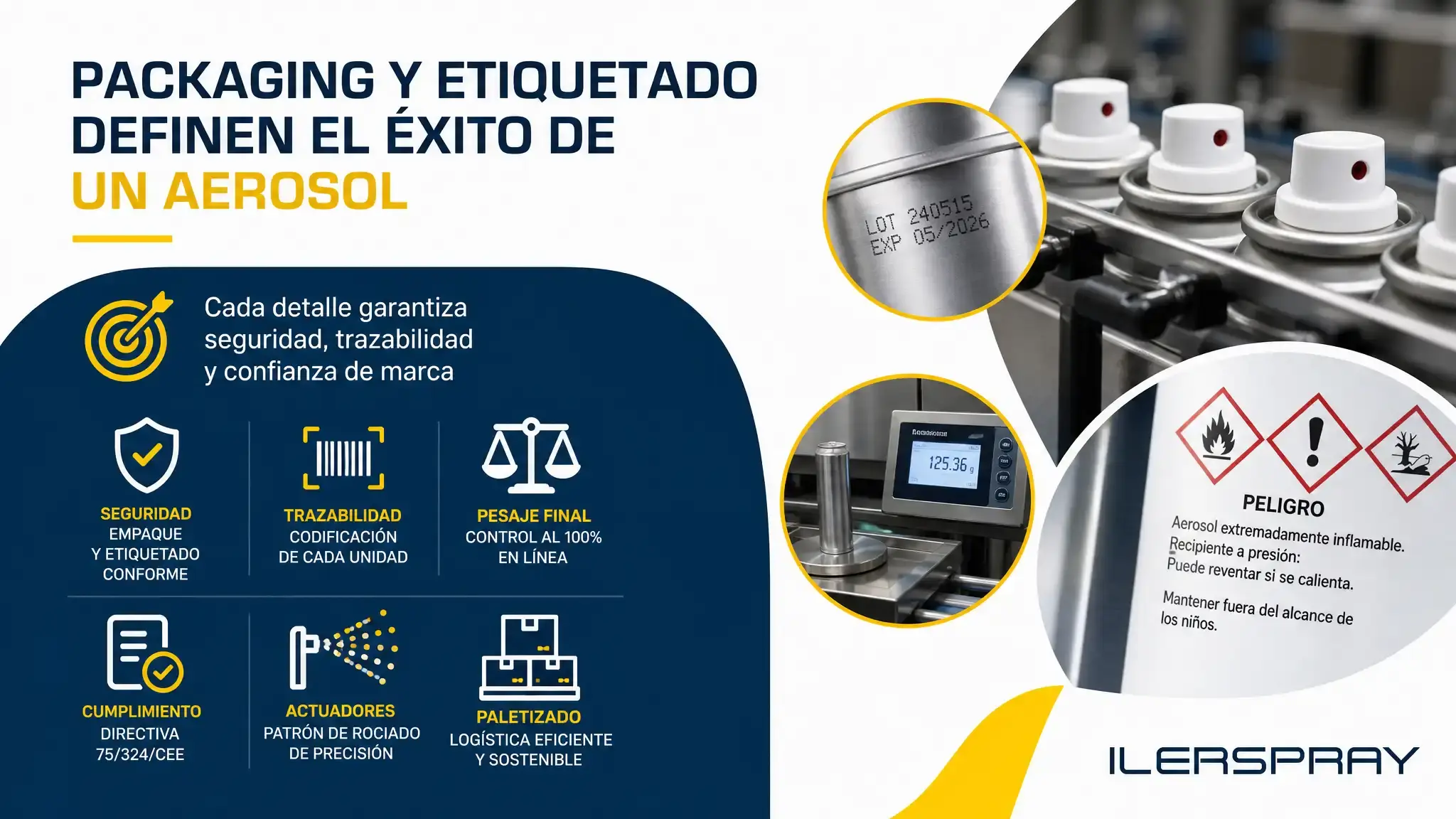
Traceability in aerosols goes far beyond simple labeling. Each unit receives a unique digital identity that allows its entire history to be tracked from raw materials to the final consumer. This capability not only meets regulatory requirements but has also become a crucial competitive advantage.
According to the ISO 8402 standard, traceability is defined as "the ability to trace the history, application, or location of a product by means of recorded data." In aerosol manufacturing, this definition takes on special relevance given the strict regulatory framework governing the industry.
Advanced Coding Systems
Modern systems use codes that include information on manufacturing date, batch number, production line, shift, responsible operator, and even environmental parameters such as temperature and humidity during production. This information is compressed into alphanumeric codes, QR codes, or RFID chips according to specific needs.
Thermal inkjet printers, such as those in the TJX series mentioned by United Barcode Systems, can print directly onto different substrates without maintenance, as each cartridge is equivalent to a new print head.
Emerging Technologies in Traceability
RFID technology is gaining ground in premium applications, allowing not only identification but also monitoring of environmental conditions throughout the supply chain. Smart tags can record exposure to extreme temperatures, impacts, or even tampering attempts.
New generation QR codes can store up to 4,296 alphanumeric characters, enough to include detailed sustainability information, personalized instructions for use, or even links to the brand's multimedia content.
"Traceability is regulated by the ISO 8402 standard. Companies that implement industrial labeling procedures and systems can access complete historical information about their products" - SINCI, industrial identification specialists
Weighing and Final Control: Precision Down to the Last Gram
Weight control represents one of the most critical verifications in aerosol packaging. Minimal variations can indicate filling problems, microscopic leaks, or assembly defects that could compromise the safety or functionality of the product.
Modern industrial scales operate with a precision of ±0.1g on lines processing more than 1,000 units per minute. The systems use high-precision load cells combined with compensation algorithms that eliminate production line vibrations and temperature variations.
Dynamic Weighing Systems
Dynamic weighing systems allow weight verification without stopping the production flow. Units pass over high-speed load cells that capture weight in milliseconds, even with the product moving at speeds of up to 2 meters per second.
Weight data is automatically correlated with traceability codes, creating detailed records that can be statistically analyzed to detect production trends and optimize processes.
Intelligent Anomaly Detection
Modern systems not only detect units out of specification but also use artificial intelligence to identify patterns that could indicate emerging problems on the production line. A gradual increase in weight variation can alert to wear in the filling valves before defective units are produced.
Industrial standard: Modern lines maintain defect rates below 0.01% through continuous automated control, exceeding traditional pharmaceutical industry standards.
How to Ensure Maximum Efficiency in Packing and Palletizing?
Packing and palletizing represent the last opportunity for optimization before the product begins its journey to the final consumer. Modern automated systems not only pack products but optimize every logistical aspect to maximize efficiency and minimize costs.
Smart Packaging Systems
Packing robots use artificial vision to automatically identify the product type and select the optimal packing pattern. Algorithms consider factors such as product dimensions, fragility, weight, and final destination to determine the ideal box configuration.
Packaging materials have evolved significantly: high-strength corrugated cardboard, biodegradable films, and protection systems that automatically adapt to the product's shape. Some lines use expandable foam that solidifies only around the product, providing customized protection.
Advanced Logistics Optimization
Palletizing systems consider not only pallet stability but also factors such as truck weight, load distribution, and even weather conditions during the journey. Algorithms can calculate more than 10,000 possible configurations in seconds to find the optimal combination.
Logistics labeling includes SSCC (Serial Shipping Container Code) codes that allow real-time GPS tracking, automatic arrival alerts, and even consumer notifications regarding the status of their order.
Advanced Labeling and Final Decoration: More Than Just Information
Modern labeling has transcended its informative function to become a marketing and differentiation tool. Smart labels combine function and form, providing regulatory information while reinforcing brand identity and creating emotional connections with the consumer.
Thermo-sensitive inks change color to indicate optimal usage temperature, especially useful in automotive or industrial products. Photochromic inks react to UV light, useful for products with sunscreens or those requiring light protection.
Sustainable and Functional Labeling
Biodegradable labels made from materials such as PLA (polylactic acid) or modified starch respond to the growing demand for sustainability. These labels maintain durability during the product's useful life but degrade completely under industrial composting conditions.
Water-based adhesives have gradually replaced traditional solvents, reducing VOC emissions and improving working conditions in production plants.
"Labels for the chemical sector are characterized by their tear resistance, chemical resistance, and ultraviolet light resistance. Safe functionality is a basic requirement" - Etimak, industrial label specialists
🌱 Sustainable Trends: The Green Future of Packaging
Sustainability has moved from being a trend to becoming a fundamental requirement. By 2025, the global sustainable packaging market is expected to reach $35.6 billion, growing at an annual rate of 8.6% according to GM Insights.
Aerosol packaging faces unique sustainability challenges due to the pressurized nature of the product. However, innovations are revolutionizing the sector: aluminum cans with up to 90% recycled content, actuators made from bioplastics, and labeling systems that facilitate material separation for recycling.
Innovative Materials and Circular Economy
Bioplastics based on algae or agricultural waste are finding applications in actuators and caps. These materials maintain mechanical properties similar to traditional plastics but degrade completely in 12-18 months under natural conditions.
The concept of "circular packaging" introduces containers specifically designed for multiple life cycles. Some premium brands offer refill programs where the consumer returns the empty container for refilling, reducing environmental impact by up to 80%.
Trends for 2025 include minimalist packaging that reduces materials without losing visual impact, 3D printing technologies that eliminate excessive inventories, and digital customization systems that optimize resources.
Emerging Technologies: The Digital Packaging Revolution
The integration of digital technologies is radically transforming aerosol packaging. NFC (Near Field Communication) chips embedded in labels allow for interactive experiences: the consumer can access detailed product information, correct usage videos, or even loyalty systems.
Augmented reality is creating immersive experiences where the consumer can visualize the product in action simply by focusing on the label with their smartphone. Spray paint brands use this technology to show final results on different surfaces.
Artificial Intelligence in Quality Control
AI-powered machine vision systems can detect microscopic defects in labels, color variations imperceptible to the human eye, or even predict adhesion problems based on historical patterns.
Machine learning continuously optimizes packaging processes, adjusting parameters such as label application pressure, heat-sealing temperature, or line speed to maximize quality and efficiency.
Ilerspray: Innovation and Excellence in Integral Packaging
Ilerspray positions itself as a leader in integral aerosol packaging in Spain, combining cutting-edge technology with expertise accumulated over more than a decade of operation. From its facilities in Lleida, the company offers complete solutions ranging from packaging design to distribution logistics.
Its three automated packaging lines process everything from pilot batches of 5,000 units to mass production, maintaining quality standards that exceed international requirements. The company has developed unique capabilities in sustainable packaging, being a pioneer in the use of biodegradable materials for actuators and ecological labeling systems.
"Our goal is to be a reliable partner for our clients. We are committed to continuous innovation to offer effective and safe products that meet the strictest quality standards" - Ilerspray
Ilerspray's own brands, APP for cosmetics and home, and Le-Brill for automotive and industrial, demonstrate the excellence of its packaging processes. Each product reflects the attention to detail that characterizes the company: from precision actuators to labeling resistant to extreme conditions.
As a strategic partner, Ilerspray not only executes packaging specifications but also collaborates in the development of innovative solutions that differentiate products in competitive markets.
The Future of Aerosol Packaging
Aerosol packaging is undergoing an unprecedented transformation driven by digitalization, sustainability, and mass customization. Emerging technologies such as blockchain for absolute traceability, IoT sensors for real-time monitoring, and smart materials that react to the environment will define the next decade.
The convergence of these trends will create packaging experiences that go beyond traditional functionality: containers that communicate with the user, adapt to specific usage conditions, and actively contribute to global sustainability.
Companies that master this technical and regulatory complexity, such as Ilerspray, will be positioned to lead an industry that continues to evolve toward smarter, more sustainable, and user-centric solutions. Aerosol packaging is not just the final presentation: it is the promise of quality, safety, and responsibility that each brand makes to its consumers.