Back to blog
Articles

Aerosol Regulation Guide in Spain and Europe 2026

Aerosol Regulation Guide in Spain and Europe 2026

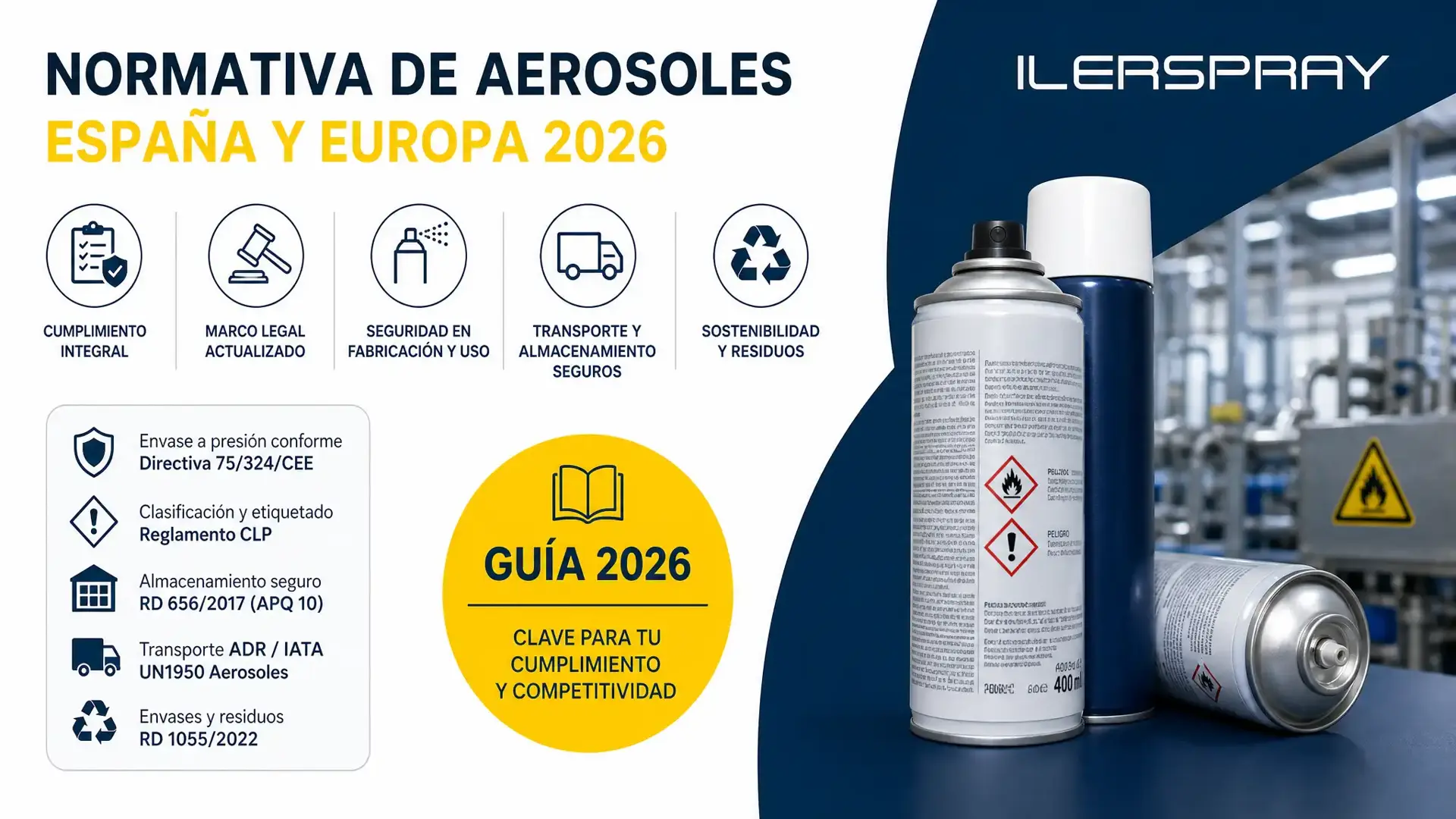
Aerosol regulation in Spain and Europe in 2026 is not “a single law”: it is a set of requirements that intersect (pressure packaging safety, chemical classification, storage, transport, waste, documentation, and prevention). Since 2024, the regulatory focus has also intensified on sustainability and the climate impact of certain propellant gases.

This guide is designed for product, quality, purchasing, R&D, EHS, and logistics managers. The goal is for you to be able to review your compliance in an orderly manner: what applies, why it applies, and what evidence should be kept.

In the European Union, aerosols are regulated from two main angles. On one hand, the pressure packaging (aerosol dispenser safety) is governed by Directive 75/324/EEC and its technical annex, which sets design criteria, limits, tests, and marking so that the container is safe during manufacturing, transport, storage, and use.

On the other hand, the chemical content (mixture and components) is controlled through the European chemical framework: the CLP Regulation for classification and labeling, and REACH for information obligations and safety data sheets. In practice, an aerosol “complies” when the container is compliant and the mixture is correctly classified, labeled, and documented, with safety measures aligned with actual risks.

There is also horizontal legislation that impacts aerosols even if it doesn't mention them: waste and packaging regulations, dangerous goods transport rules (road, sea, and air), and occupational risk prevention. This requires coordinating several internal areas: engineering and quality (packaging), regulatory (labeling and SDS), logistics (ADR/IATA), and environment (waste, packaging, and increasingly, climate footprint).

“The objective of CLP is to ensure a high level of protection of human health and the environment.”

This idea, included in the text of the CLP Regulation itself, explains why the label and the SDS are so central to the aerosol, even when the container is technically flawless.

In operational terms, it is useful to think in “compliance layers”: product (formulation + packaging), facility (storage and handling), and logistics chain (transport and shipping). If one layer fails, the legal and safety risk multiplies.

📘 Main Directives: From 75/324/EEC to the 2024 Updates

Directive 75/324/EEC remains the specific pillar for aerosols. Its consolidated text covers the scope (what an aerosol dispenser is), exclusions, capacities, pressures, resistance requirements, and the annex with technical provisions.

A key update was Directive (EU) 2016/2037, which adjusted labeling provisions to align them with the CLP Regulation. The change is relevant because it consolidates consistency: the aerosol is not labeled “by sector tradition,” but under a harmonized system of pictograms, H and P phrases, warnings, and classification criteria.

However, when we talk about “2024 updates,” many are not direct changes to 75/324/EEC, but to the surrounding context. The clearest example is the climate regulation of fluorinated gases (F-gas), which conditions propellant options and transition strategies. In February 2024, Regulation (EU) 2024/573 was approved, repealing the previous 517/2014 framework and strengthening control over fluorinated greenhouse gases.

National obligations related to packaging and waste have also continued to mature, with entry-into-force milestones that pressure manufacturers and brands to improve traceability and extended producer responsibility (EPR) systems. Although part of the schedule unfolds in 2025, in 2024 many companies have already had to prepare data and contracts to comply on time.

In summary: “2024 aerosol regulations” are best understood as an ecosystem where the packaging directive remains stable, while the chemical, environmental, and logistics framework increases the level of documentary and control requirements in the chain.

🛠️ Essential Manufacturing and Packaging Design Requirements

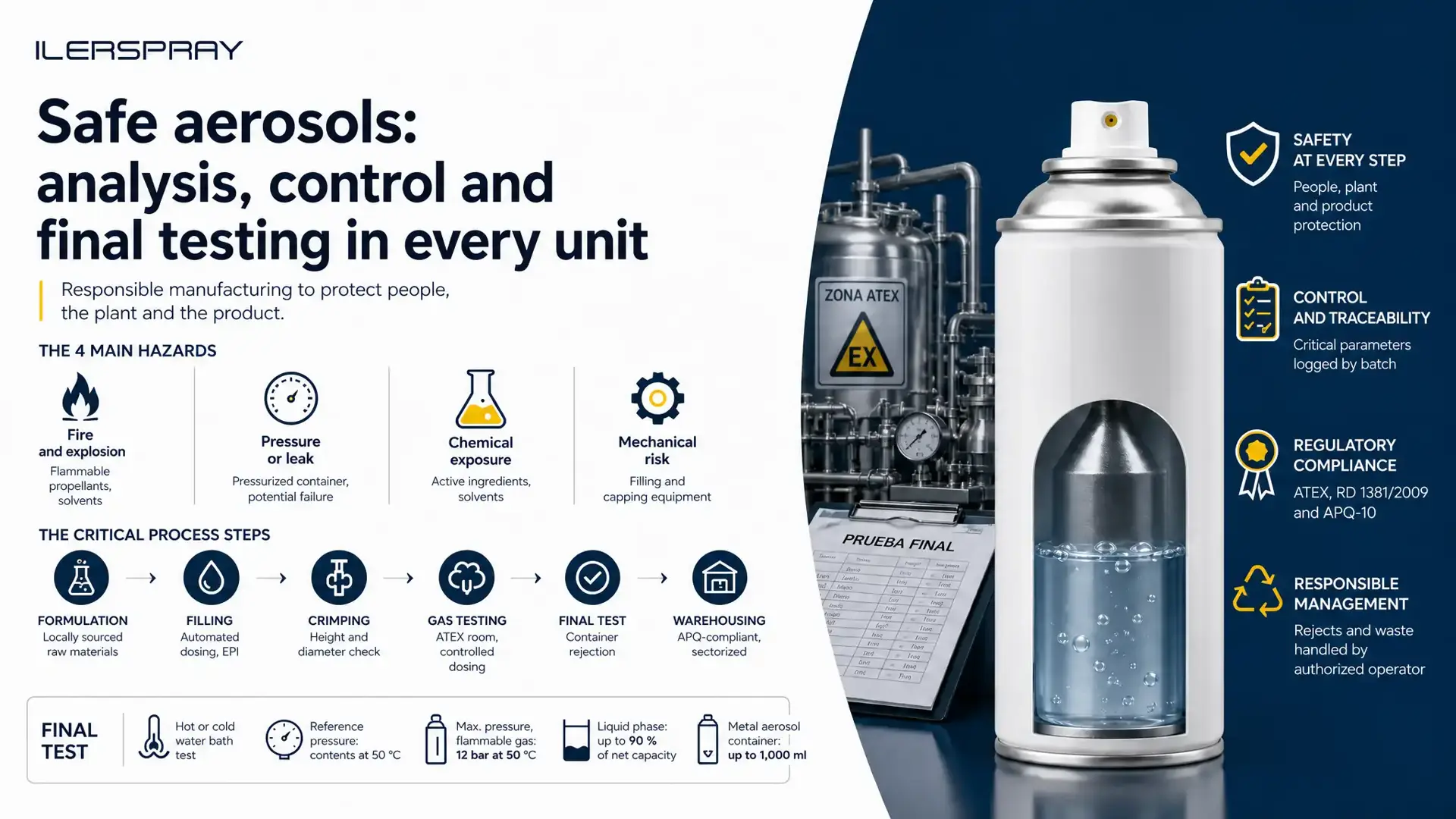
The aerosol dispenser is, essentially, a non-refillable container with pressurized gas, with or without liquid, equipped with a discharge device. Directive 75/324/EEC details a set of technical requirements: capacity limits, compatibility and resistance of the container, closure control, and conditions to prevent leaks or failures due to pressure. The result the standard seeks is simple: that the container be safe under reasonably foreseeable conditions.

In manufacturing, this translates into process controls and routine tests. Without going into specific internal procedures (which vary by plant), the regulatory approach requires the manufacturer to be able to demonstrate that the container and the valve-cup assembly meet the parameters of the technical annex and that consistency is maintained batch to batch. Marking and safety warnings regarding pressure and heat must be present when applicable, and the product must be designed to minimize misuse.

From a design point of view, there are three critical points that usually concentrate audits and claims: (1) pressure resistance (avoiding dangerous deformation or rupture), (2) leak-tightness (avoiding gas or mixture leaks), and (3) chemical compatibility (avoiding internal corrosion or degradation of components). Although CLP and REACH “talk” about the content, experience shows that a compatibility problem can become a physical incident with an impact on safety and reputation.

A good compliance practice is to keep structured evidence: technical data sheets for components, packaging specifications, acceptance criteria, test results by batch or defined frequency, and change logs (for example, valve supplier or internal varnish substitutions). The standard expected by authorities and customers is not to “promise,” but to be able to demonstrate.

“The Directive applies to aerosol dispensers… as defined in Article 2.”

This phrase from the consolidated text serves as a reminder that compliance starts with a correct determination of scope: if it is a regulated aerosol, there are no shortcuts.

⚠️ Classification and Labeling under the CLP Regulation

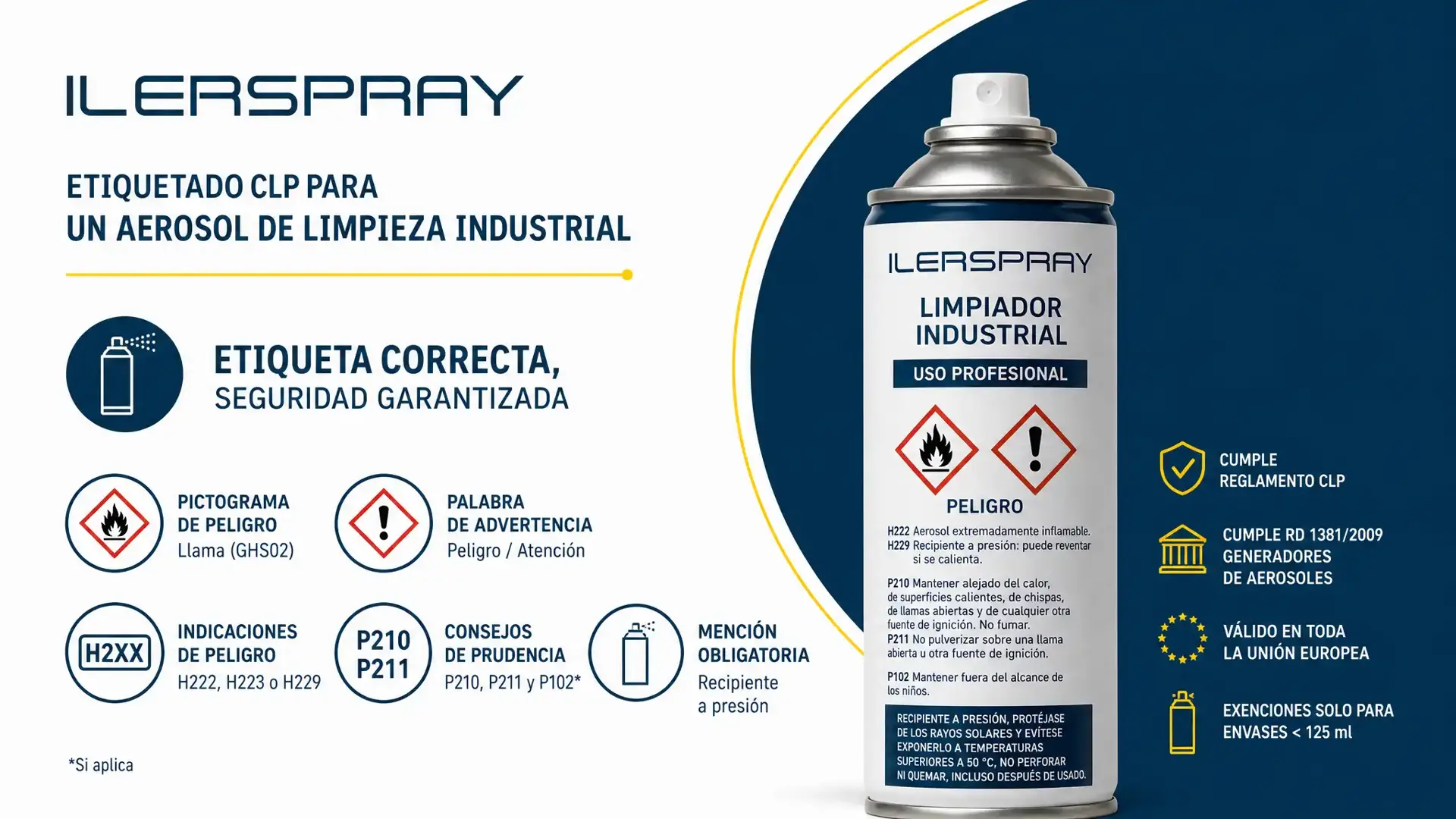
Regulation (EC) 1272/2008 (CLP) defines the European system for classification, labeling, and packaging of hazardous substances and mixtures. For aerosols, CLP is particularly relevant for two reasons: flammability and pressure.

In CLP, there are specific hazard statements for aerosols: H222 (extremely flammable aerosol) and H223 (flammable aerosol), among others that may apply depending on the mixture (irritation, toxicity, sensitization, etc.). These H-phrases appear in annexes and official reference materials from the health administration.

The label, in addition to pictograms and signal words, must include product identifiers, supplier data, and precautionary statements (P-phrases) that reflect actual risks (for example, keep away from heat, do not pierce or burn, avoid inhalation, etc.). The goal is not to “fill the label,” but to communicate risks and prevention measures in an intelligible and consistent way.

A typical error in audits is treating the aerosol as “logistics category UN1950” and copying markings without reviewing the CLP classification of the mixture. These are different areas: UN1950 classifies dangerous goods for transport; CLP classifies hazards for the user and the environment. They must coexist, but they do not replace each other.

Another sensitive area is the consistency between the label and the Safety Data Sheet (SDS). If the SDS indicates a different classification than the label, or if components change without updating both, the risk of non-compliance skyrockets. In 2024, with increasing pressure on traceability and transparency, documentary consistency has become a competitiveness factor: large distributors and industrial customers penalize inconsistencies with supply blocks.

“H222… Extremely flammable aerosol. H223… Flammable aerosol.”

This official reference helps avoid creative interpretations: the H-phrases applicable to aerosols are standardized.

🏭 Safety Standards in Industrial Storage (APQ 10)

In Spain, the storage of chemical products is regulated by Royal Decree 656/2017, which approves the Regulation for the Storage of Chemical Products and its Complementary Technical Instructions (ITC) MIE APQ 0 to 10. Within that framework, ITC MIE APQ-10 focuses on storage in mobile containers, a common fit for aerosols and other transportable packaging.

APQ-10 establishes technical requirements for storage, loading, unloading, and transfer facilities for hazardous chemical products in mobile containers. The goal is to reduce risks of fire, explosion, exposure, and spills through conditions of sectorization, ventilation, control of ignition sources, distances, and fire protection measures, among others.

In aerosols, the hazard classification of the product (for example, flammable) conditions the storage design: a cosmetic aerosol with limited risk is not the same as a highly flammable technical aerosol, nor is a shipping warehouse the same as a production area with constant transfers and handling.

To comply solidly, it is advisable to document: maximum inventory, compatibilities, handling instructions, signage, emergency equipment, maintenance of fire protection systems, and a clear incident management procedure (leak, dent, fire). APQ-10 is not “passed” with a piece of paper: it is demonstrated through installation, operation, and records.

In practice, many companies fail for small reasons: accumulation outside designated areas, lack of segregation by compatibility, or absence of evidence of training. The recommended approach is to treat APQ-10 as a daily operational standard, not as an annual formality.

Regulatory reference (BOE text): Royal Decree 656/2017 (APQ).

🚚 Transport of Dangerous Goods: The Role of ADR and IATA

In transport, aerosols are usually classified as UN 1950 AEROSOLS and fall under Class 2 (gases). On the road, ADR (European Agreement concerning the International Carriage of Dangerous Goods by Road) applies, which is updated periodically and defines requirements for classification, packaging, marking, documentation, and training.

In ADR, UN1950 includes special provisions (for example, 190, 327, 344, 625) and limited quantity rules that, when applicable, simplify certain obligations (without eliminating them). The ADR table disseminated by the competent Ministry in Spain reflects for UN1950 the typical limited quantity of 1 L, and other operational keys affecting shipping and package labeling.

In air transport, the operational reference for the sector is IATA DGR (aligned with the ICAO Technical Instructions). Air transport is more restrictive and requires special attention to limitations by aircraft type, quantities, packaging, and operator acceptance. If your company ships aerosols by air, training and the dangerous goods instruction program is a critical point; in Spain, AESA publishes guides and procedures linked to these programs.

A common mistake is underestimating the impact of the channel. By road, many aerosols circulate under LQ (Limited Quantity) routinely; by air, even “domestic” products may be restricted. Therefore, compliance must be integrated into the offer design: if a customer requires air transport, your packaging and documentation must be prepared from the start.

In shipping, always keep: assigned classification, evidence of LQ if applicable, packaging instructions used, package labels, and transport documents. Logistics traceability is one of the first things insurers and authorities look at after an incident.

Useful links (technical reference): ADR 2023 Table (Spain) - UN1950.

♻️ Waste Management and Sustainability in the Aerosol Sector

Aerosols pose specific environmental challenges: metal or plastic packaging, valve and components, and potential product residue and pressurized gas. At the waste level, the principle is clear: manage end-of-life by minimizing risks and maximizing material recovery. If there is hazardous content or remaining pressure, the waste may be treated as hazardous, with additional safety and traceability requirements.

In Spain, the framework for packaging and packaging waste is defined by Royal Decree 1055/2022, which sets the legal regime to prevent and reduce the environmental impact of packaging throughout its life cycle. For companies that put packaged products on the market (packagers, importers, or intra-community acquirers), this connects directly with extended producer responsibility (EPR) obligations, information, and, in certain cases, membership in collective systems (SCRAP).

In 2024, many organizations have accelerated preparation because part of the obligations take effect from 2025. Law firms and business associations have pointed out the practical impact: the need for data, contracts, and internal processes to report and finance waste management according to the standard.

In sustainability, in addition to packaging, the debate on propellants and climate footprint is gaining strength. Some sectors are pushing towards technologies and gases with lower impact, and decisions are linked to availability, safety (flammability), cost, and climate regulation. This connects with Regulation (EU) 2024/573 on fluorinated gases, which tightens the framework for gases with high global warming potential and accelerates the transition.

A realistic sustainability strategy for aerosols usually includes: ecodesign of the packaging (lightweighting, recycled content where viable), improvement of recyclability, clear instructions to the consumer/user, and evaluation of propellant alternatives when use allows. The key is to avoid documentary greenwashing: if you promise circularity, you must support it with data and traceability.

Regulatory link (BOE): Royal Decree 1055/2022 on packaging and packaging waste.

📄 Mandatory Documentation: Safety Data Sheets and EC Declaration

In aerosols, documentation is not an appendix: it is part of the product. The Safety Data Sheet (SDS) is mandatory when the mixture meets hazard criteria and must be aligned with REACH and CLP. In 2020, Regulation (EU) 2020/878 was approved, replacing Annex II of REACH and establishing new format and content requirements for SDS, with transition periods now concluded.

This regulation reinforces, among other points, consistency with CLP, the inclusion of relevant information for risk management, and communication aspects in the supply chain. An important practical element is that it requires precision and structure: if your SDS “looks” old, it probably is, and it can be a problem in inspections or customer audits.

“Annex II… sets out requirements for the compilation of safety data sheets.”

It is a simple phrase, but it defines a standard: the SDS has a mandatory format and minimum content; it is not a free-form document.

In addition to SDS, at the packaging level, there must be evidence of compliance with Directive 75/324/EEC. In common sector language, people talk about “declaration” or “conformity” to demonstrate that the aerosol dispenser meets the applicable provisions. The specific form of this evidence depends on how the company structures its quality system, but the goal is to be able to justify that the product has been designed and manufactured according to the technical annex and that the required marking is present.

For industrial customers, logistics documentation is also usually critical: applied ADR/IATA classification, and consistency with SDS in the transport section. In practice, the most repeated question is: “Does what is stated in section 14 of the SDS match what you are shipping?”. The answer must be yes, and it must be demonstrable with label samples and shipping documentation.

Recommended minimum documentary checklist for audit: current SDS (2020/878), approved final label, product specification, evidence of packaging control/testing, ADR/IATA classification (if applicable), and change log.

🧯 Occupational Risk Prevention in Aerosol Handling

In the workplace, aerosols combine chemical risks (exposure by inhalation or contact) and physical risks (flammability, pressure, projection). In Spain, Royal Decree 374/2001 sets minimum provisions for protection against chemical agents during work. It requires risk assessment, adoption of preventive measures, and prioritization of technical/organizational controls over PPE whenever possible.

INSST maintains a technical guide that helps interpret and apply these requirements in a practical way: exposure assessment, measures, surveillance, information, and training. For aerosol operations (filling, handling, industrial use), this guide is useful for pinning down “what to do” with technical criteria.

When the aerosol or its environment generates a risk of explosive atmospheres (flammable vapors, mists, leaks), Royal Decree 681/2003 (ATEX in the workplace) comes into play, requiring the assessment of explosion risk, classification of zones where appropriate, implementation of prevention/protection measures, and preparation of associated documentation.

“The employer shall determine… whether any hazardous chemical agents are present at the workplace.”

This mandate summarizes the basic principle: before deciding on PPE or ventilation, you must identify and evaluate with judgment. {index=27}

Good compliance practices in the plant or warehouse: specific training (including interpretation of labels and SDS), handling procedures (avoiding piercing, impacts, heat), adequate ventilation, ignition control, and emergency response (leak/fire). In audits, the most valued evidence is usually the combination of assessment (document), implementation (facility/procedure), and verification (records, drills, maintenance).

If your business is B2B, do not underestimate the commercial value of well-documented prevention: many industrial customers require EHS evidence before approving suppliers. In aerosols, prevention not only avoids accidents; it also accelerates sales and reduces friction in the supply chain.

The regulatory debate on propellants has intensified due to the tension between safety (flammability), performance (spraying and stability), industrial availability, and climate. In 2024, Regulation (EU) 2024/573 on fluorinated gases strengthens the framework for reducing emissions and controlling the marketing of gases with high climate impact, pushing for a review of alternatives and technological roadmaps.

The practical effect is not identical for all aerosols: many products use hydrocarbons or compressed gases that are not fluorinated; other niches may have relied on gases with climate impact. In any case, the underlying trend is clear: more pressure to quantify, justify, and, where viable, substitute. Interpretive guides and sector documents on 2024/573 help understand scope and definitions (what is considered a fluorinated gas, which annexes apply, and what obligations unfold).

Another trend is indirect tightening via customers and distribution. Even if a standard does not prohibit a propellant in your specific case, a retailer or an industrial customer may incorporate purchasing criteria (footprint, restricted substances, ecodesign) that, in practice, function as “market regulation.” Those who anticipate with a transition plan and technical evidence usually have a competitive advantage.

In parallel, the standardization of packaging and EPR obligations in Spain will drive more reporting and traceability in the coming years. For aerosols, this means that “compliance” will be increasingly digital: material data, weights, packaging composition, and proof of membership in management systems.

The strategic recommendation for 2024-2026 is simple: build a compliance matrix by product family (cosmetics, home, auto, industrial) that crosses: (1) CLP/SDS, (2) 75/324/EEC packaging, (3) ADR/IATA, (4) APQ/ATEX, (5) packaging and sustainability. That matrix reduces errors and accelerates approvals.


Ilerspray (Torres de Segre, Lleida) manufactures aerosols for brands and third parties with an industrial focus on quality, safety, and regulatory compliance, integrating labeling, documentation, and logistics requirements for demanding B2B customers.

"The quality of an aerosol is decided in the formulation. Filling only executes it — or betrays it."

— Ilerspray technical team

Ready when you are

Do you have a project in mind?

Contract manufacturing, private label, distribution, or a technical question. Write to us and we will respond with real industrial expertise.