PCR Aluminum: The Best Option for Sustainable Aerosols
The PCR aluminum —recycled aluminum of post-consumer origin (Post-Consumer Recycled)— is currently the option with the best balance between technical performance and environmental impact for aerosol packaging. Compared to primary aluminum, which is produced from bauxite through the Hall-Héroult electrolytic process, recycled aluminum retains identical barrier, mechanical, and formability properties, but carries a fraction of the carbon footprint. For a brand manufacturing under contract manufacturing, choosing packaging with PCR content is the most direct lever to reduce the embodied carbon of its product without redesigning the formula or the filling line.
The reason is physical rather than marketing-related: recycling aluminum avoids repeating the most energy-intensive phase of the metal's entire life cycle, the electrolytic reduction of alumina. This is why aluminum packaging is also one of the few packaging materials that can be recycled indefinitely without loss of quality, making it the natural foundation of a circular packaging model.
Key Takeaways
Before diving into the technical details, here are the keys that summarize why PCR aluminum dominates the debate on sustainable aerosol packaging:
What Is PCR Aluminum and How Does It Differ from Primary Aluminum
PCR aluminum is metal recovered from products that have already reached the end of their useful life —cans, packaging, profiles— after passing through the consumer, sorted, remelted, and reintroduced into the supply chain. It is distinguished from pre-consumer recycled aluminum (factory waste and scraps that never reached the market) precisely by that step through the end user, which is what sustainability audits value as "real" and traceable recycled content.
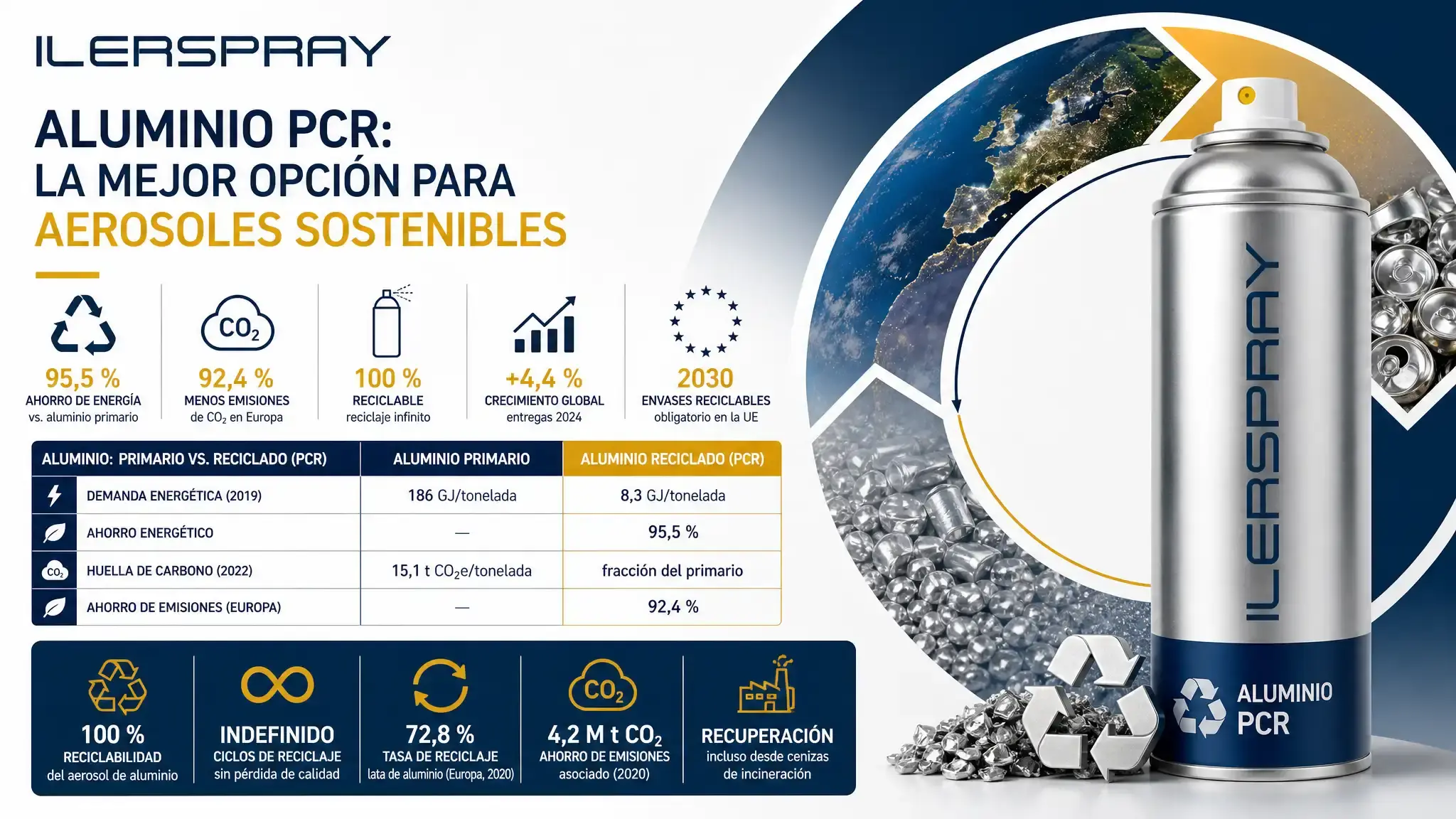
The difference with primary aluminum is enormous in terms of process. Primary aluminum is obtained from bauxite through high-temperature electrolysis, a method that the International Aluminium Institute itself describes as energy-intensive and, above all, electricity-intensive. In 2019, the global primary energy consumption to produce primary aluminum —from mine to smelter— was 186 gigajoules per ton, while the energy demand for recycled aluminum was only 8.3 GJ per ton.
This gap is the key to the entire argument. Remelting aluminum scrap requires only a fraction of the temperature and energy of electrolytic reduction because the metal is already in a metallic state and does not have to be "wrested" from an oxide.
Furthermore, aluminum does not degrade when recycled: its mechanical and barrier properties are maintained cycle after cycle. This is why it is referred to as a material suitable for indefinite recycling, unlike other packaging materials that lose quality with each turn through the circuit.
For aerosol packaging, this matters doubly because the can must resist internal pressure, withstand the propellant, and guarantee leak-tightness for years. PCR meets exactly the same technical specifications as virgin aluminum, so changing the material does not require modifying valves, wall thicknesses, or filling parameters.
The Carbon Argument: How Much PCR Actually Saves
The data supporting the entire sustainability conversation is the carbon footprint of primary aluminum. According to data from the International Aluminium Institute, in 2022 the carbon footprint of global primary aluminum production, from mine to smelter, was 15.1 tons of CO₂e per ton of metal. It is one of the highest figures for any mass-use packaging material.
Recycled aluminum reverses almost all of that burden. The same organization quantifies that recycling not only saves 95% of the energy but a similar percentage of greenhouse gas emissions: 92.4% in Europe, comparing cradle-to-gate emissions of primary aluminum versus gate-to-gate emissions of recycled aluminum. In other words, every kilo of primary aluminum replaced by PCR eliminates about nine-tenths of the carbon associated with that kilo of metal.
| Indicator | Primary aluminum | Recycled aluminum |
|---|---|---|
| Energy demand (2019) | 186 GJ/ton | 8.3 GJ/ton |
| Energy savings | — | 95.5% |
| Carbon footprint (2022) | 15.1 t CO₂e/t | fraction of primary |
| Emissions savings (Europe) | — | 92.4% |
Commercial examples confirm the order of magnitude. The post-consumer certified recycled aluminum Hydro CIRCAL 75R, used by profile manufacturers, declares a footprint of only 1.9 kg CO₂eq per kg of aluminum, according to Technal, compared to the average for primary metal.
💡 Manufacturer's tip: when setting a PCR content goal, demand certification of post-consumer origin and the footprint data per kilo from the packaging supplier; without traceability, the recycled percentage is not defensible in an audit or to the consumer.
This differential explains why the embodied carbon of the packaging has become an industrial purchasing criterion and not just a simple label message.
Infinite Recyclability: The Aerosol as Circular Packaging
PCR aluminum only makes sense if the packaging containing it re-enters the circuit at the end of its life. And here the aerosol starts with an advantage: it is 100% recyclable and its metal can be recovered again and again. The whitepaper Aerosol Cans in Europe: A Story of Infinite Recyclability highlights that, thanks to its high recycling rates and the material's ability to be recycled infinitely, metal packaging has become one of the preferred options for brands looking to strengthen their circularity.
The real circuit works even when waste is not perfectly separated. That same document points out that aerosol metal —steel and aluminum— can be recovered directly from incineration bottom ash, a common practice in Europe, so the material is rarely lost unless it ends up in a landfill.
Rates confirm the material's good performance. A report cited by Packaging Europe, commissioned by Metal Packaging Europe and European Aluminium, estimated the recycling rate for aluminum cans in the EU, UK, Switzerland, Norway, and Iceland at 72.8% in 2020, with an associated saving of 4.2 million tons of CO₂.
This is the point that closes the circle of the PCR argument: the more aluminum is recycled, the more high-quality secondary aluminum is available to manufacture new packaging, feeding a loop that progressively reduces dependence on primary metal.
- Aluminum aerosol recyclability
- 100%
- Possible recycling cycles
- indefinite, without loss of quality
- Aluminum can recycling rate (Europe, 2020)
- 72.8%
- Associated emissions savings (2020)
- 4.2 M t CO₂
- Possible recovery
- even from incineration ash
For the packaging designer, the practical conclusion is that an aluminum aerosol with high PCR content maximizes two advantages at once: it enters the market with less carbon and leaves it to be almost completely recycled.
Design for Recycling: The Condition That Makes PCR Viable
Recycled content alone is not enough; the packaging must be designed to return to the circuit with minimal complexity. The industry has understood this and placed ecodesign at the center. According to AEROBAL, the international sector organization, as reported by Packaging Europe, "design for recycling" guides are of central importance to the sector because they help the aluminum aerosol can re-enter the recycling loop with minimal packaging complexity and minimal material use.
That same report provides the market snapshot: global aluminum aerosol can deliveries grew by 4.4% in 2024, exceeding 3.4 billion units, although access to recycled aluminum remains limited and global economic tensions are putting pressure on the sector. Demand for recycled content is growing faster than the available supply, making PCR aluminum a strategic resource.
Ecodesign applied to the aerosol involves specific decisions: mono-material components whenever possible, reduction of coatings that hinder remelting, valves and diffusers compatible with sorting, and an optimized thickness that reduces material without compromising pressure resistance. Every gram of aluminum avoided is also carbon avoided.
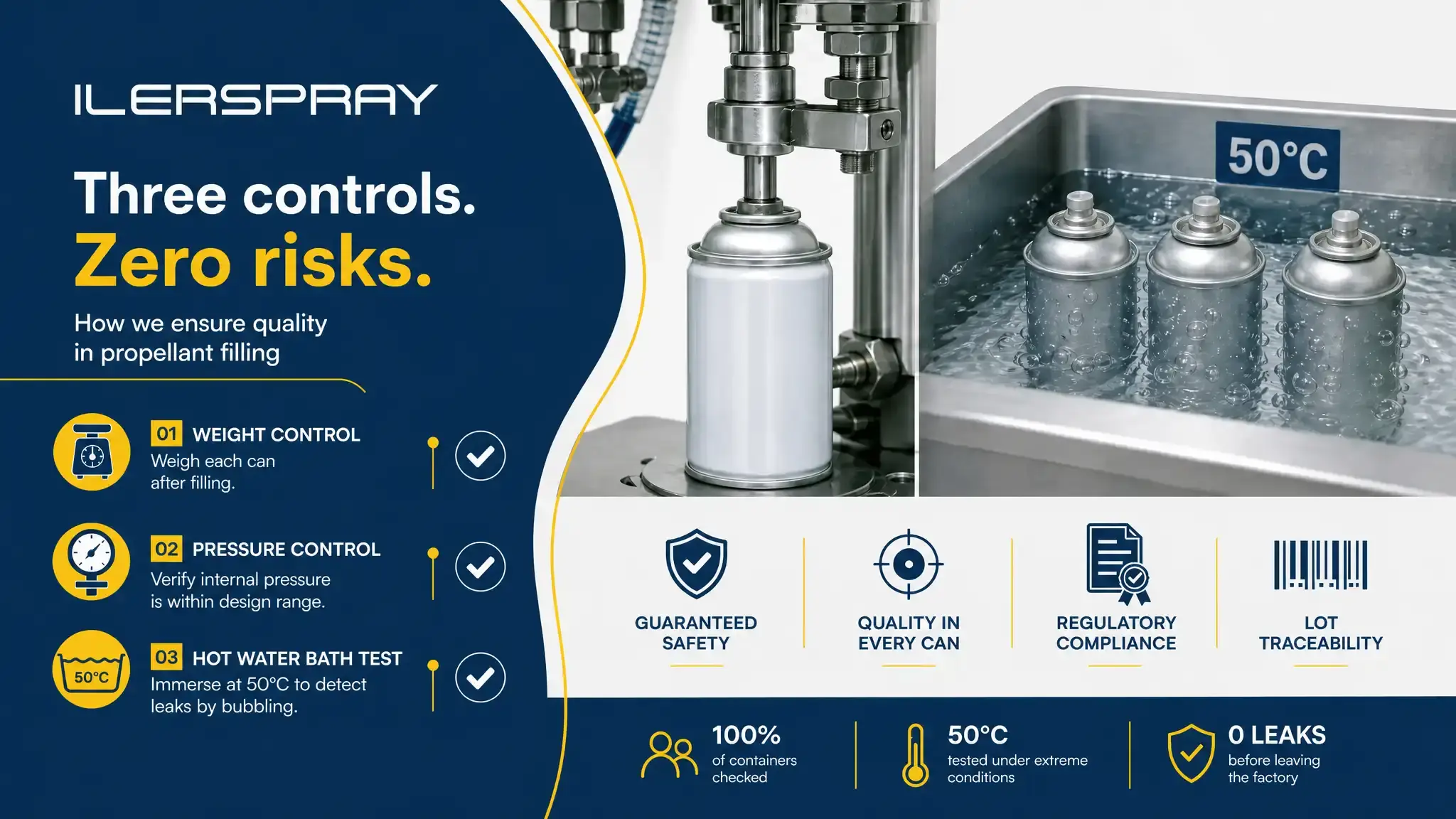
This is where contract manufacturing plays a decisive role. A specialized manufacturer can guide the brand on what proportion of PCR is technically viable for each format, how to make the recycled packaging compatible with the chosen propellant, and how to maintain quality control —including the leak detection bath— without sacrificing recycled content. Ilerspray produces in aluminum and tinplate precisely to be able to adjust that material combination for each project.
💡 Manufacturer's tip: do not chase 100% PCR as a marketing figure; define the maximum percentage your format supports without compromising pressure integrity, and prioritize a mono-material design that ensures the packaging is actually recycled at the end of its life.
Designing to recycle and buying recycled content are two sides of the same coin: without the first, the second does not close the cycle.
The Regulatory Framework Accelerating the Change
Pressure is no longer just reputational; it is regulatory. European packaging legislation is moving toward binding targets for recyclability and recycled content that will directly affect any brand selling aerosols in the European Union. According to sector analysis by Mordor Intelligence, EU rules, taking effect in 2026, require all packaging to be recyclable by 2030.
This horizon changes the calculation for brands. Aluminum, due to its intrinsic recyclability, starts in a favorable position compared to composite materials that are difficult to separate, and PCR content becomes the way to anticipate future recycled material thresholds.
The market is already moving in that direction voluntarily. The same report cites Beiersdorf's 2024 commitment to reach 50% recycled aluminum in its components, with an embodied carbon approximately 40% lower, a move that is pushing distributors to demand similar commitments from their suppliers.
| Regulatory / Market Factor | Implication for the Brand |
|---|---|
| Mandatory recyclable packaging (EU, 2030) | Advantage for aluminum due to its recyclability |
| Retailer pressure | Requirement for % of recycled content |
| Voluntary commitments (e.g., 50% PCR) | New de facto sector standard |
| Limited access to recycled material | PCR as a scarce strategic resource |
The takeaway for a home, automotive, industrial, or cosmetic brand is clear: incorporating PCR aluminum today is not just about reducing the footprint; it is about staying ahead of a framework that will make mandatory what is currently a competitive differentiator.
Frequently Asked Questions
What exactly does PCR aluminum mean?
PCR stands for Post-Consumer Recycled: aluminum recovered from products that have already been used by the consumer and have reached the end of their useful life, sorted and remelted to manufacture new metal. It differs from pre-consumer recycled aluminum, which comes from industrial waste that never reached the market.
Does recycled aluminum have worse properties than primary aluminum for an aerosol?
No. Aluminum retains its mechanical and barrier properties when recycled, so an aerosol package with PCR content meets the same technical specifications for pressure resistance and leak-tightness as one made of primary aluminum, with no changes to the valve or filling process.
How much carbon footprint is actually saved with PCR?
Recycling aluminum saves around 95% of the energy and a similar percentage of emissions compared to producing primary aluminum, which in 2022 had a footprint of 15.1 t CO₂e per ton. In Europe, emissions savings reach 92.4% according to the International Aluminium Institute.
Can an empty aluminum aerosol be recycled?
Yes. The aluminum aerosol is 100% recyclable and its metal can be recycled indefinitely without losing quality. In Europe, aluminum is even recovered from incineration bottom ash, unless the waste ends up in a landfill.
Is it mandatory to use recycled content in aerosol packaging?
European regulations require all packaging to be recyclable by 2030, and pressure from retailers and brands is establishing recycled content targets. Although specific PCR thresholds are still evolving, incorporating it today allows you to anticipate those requirements.