Aerosol Storage and APQ-10 Regulations in Spain
Aerosol storage in Spain is not something that can be improvised. Any company that manufactures, distributes, or handles these products in significant quantities is subject to precise technical regulations that govern everything from the minimum distance between shelves to the frequency of periodic inspections. Non-compliance can lead to everything from financial penalties to the suspension of activity.
The reference framework is Real Decreto 656/2017, published in the BOE on July 25, 2017, which approves the Chemical Product Storage Regulation (APQ) and its ten Complementary Technical Instructions (ITC MIE APQ-0 to APQ-10). For aerosols, the standard that applies directly is ITC MIE APQ-10, dedicated to storage in mobile containers.
📋 RD 656/2017 Requirements for the Aerosol Sector
RD 656/2017 adapts Spanish legislation to the CLP Regulation (EC 1272/2008) on classification, labeling, and packaging of hazardous substances. This means that the hazard level of an aerosol is no longer identified by generic categories, but by its hazard statements (H-phrases), which appear on the safety data sheet (SDS) for each product.
The regulation applies to newly constructed facilities, as well as extensions or modifications of existing ones. It affects both purely industrial environments and logistics warehouses, laboratories, and commercial establishments that are not open to the general public.
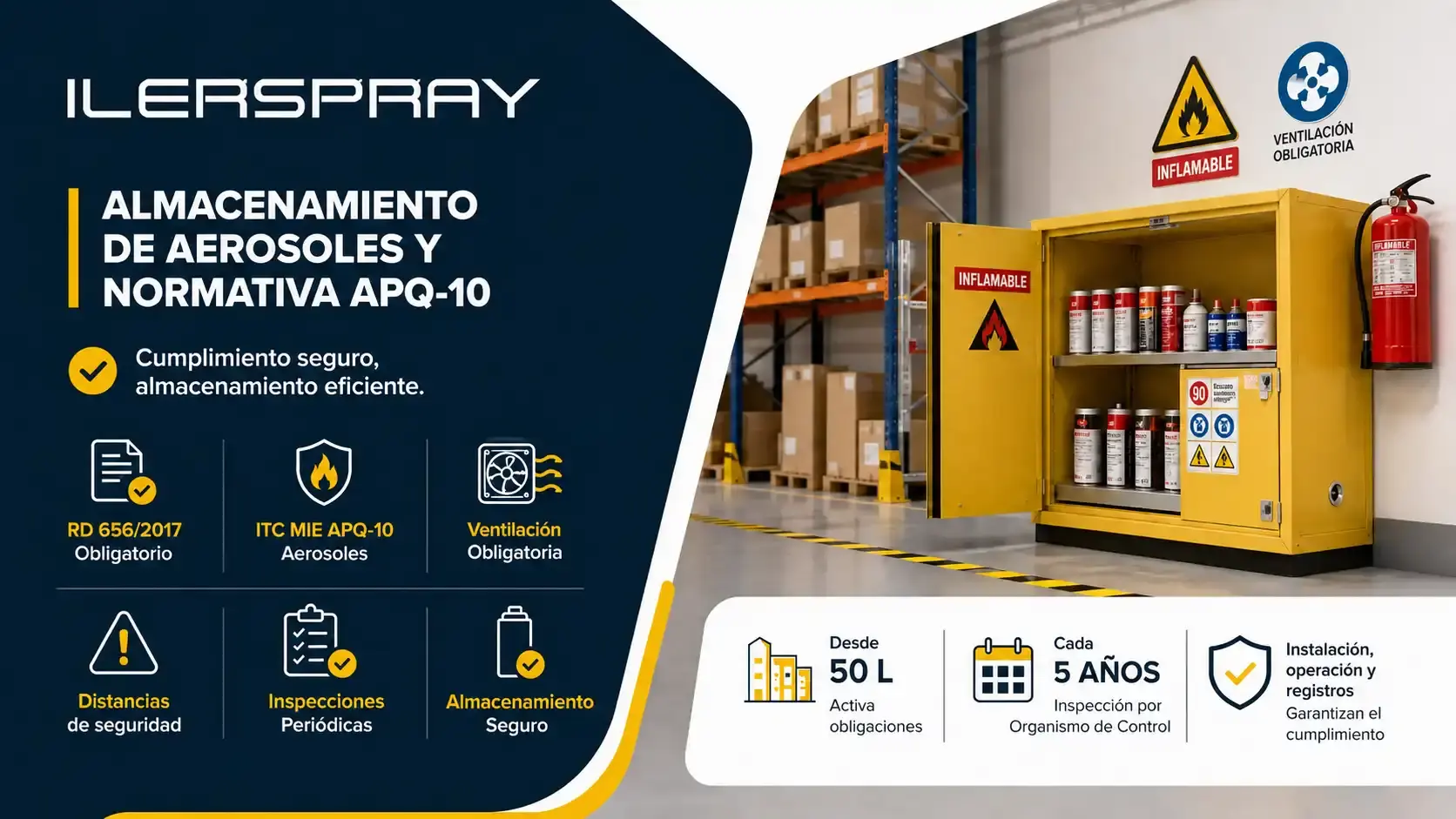
A critical aspect: the threshold for triggering obligations is very low. For flammable substances, from just 50 liters, it is already mandatory to prepare a Technical Report. Many companies are unaware of this limit and accumulate quantities that exceed the thresholds without having processed any documentation.
"The RAPQ applies starting from very small quantities. In many cases, very small amounts of flammable or hazardous substances already trigger the obligation to legalize the storage." — TÜV SÜD Iberia, experts in APQ inspection
🔧 Complementary Technical Instruction MIE APQ10
The ITC MIE APQ-10 is the specific instruction for storage in mobile containers, the category into which aerosols fit. A mobile container is defined as any container with a capacity up to 3,000 liters designed to be transported.
Aerosols are distinguished into two groups according to their hazard level: flammable aerosols and non-flammable aerosols. Each group has different technical requirements. When the same product presents several hazard indications, the most severe requirements are always applied.
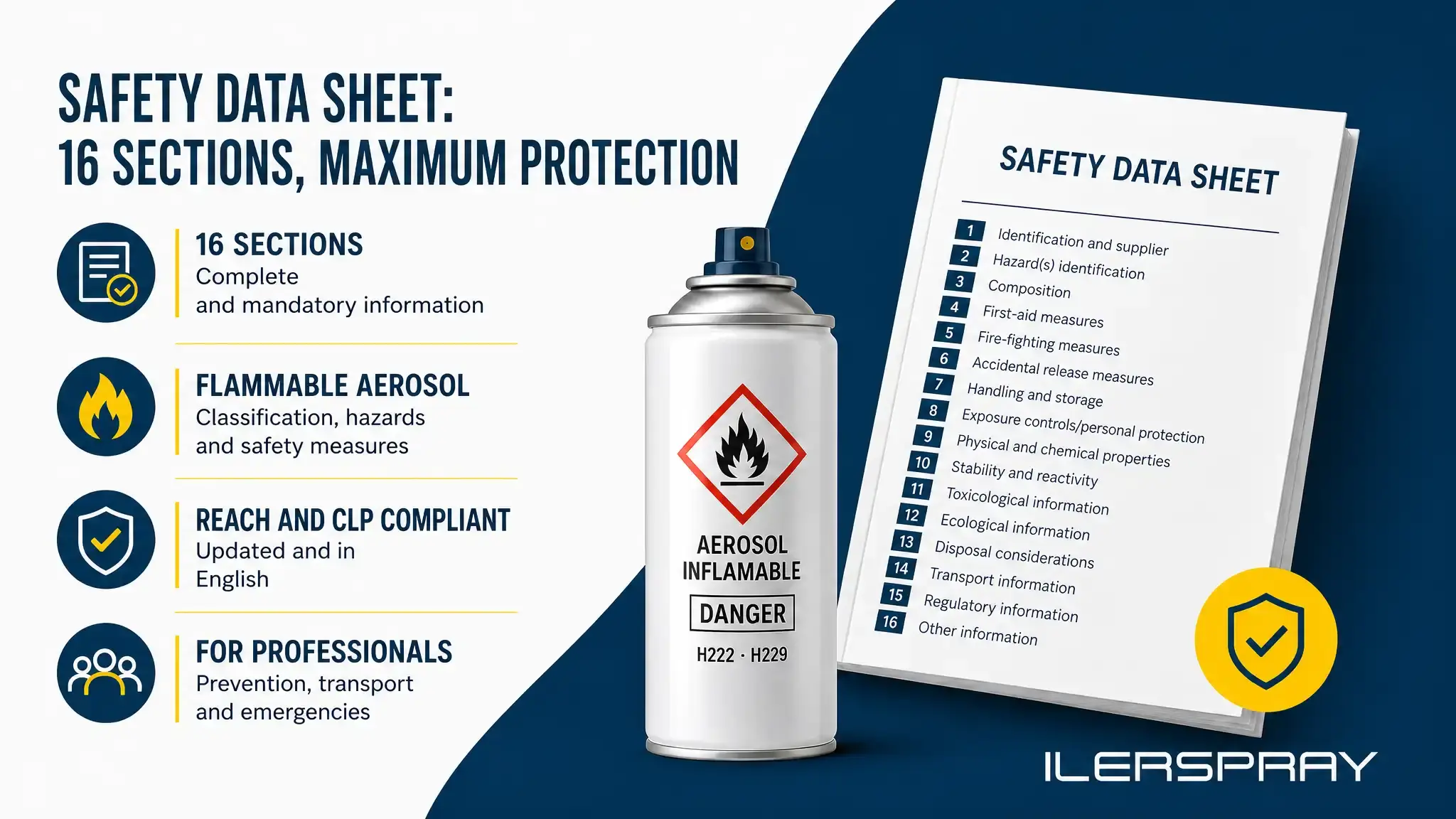
The standard establishes technical, organizational, and documentary requirements: technical report, self-protection plan, safety data sheets, inspection records, and a documented maintenance plan. It is not enough to have the paperwork: APQ-10 is demonstrated through installation, operation, and records.
💨 What Should Ventilation and Signage Be Like in Aerosol Warehouses?
Ventilation is one of the most regulated and, at the same time, one of the most neglected aspects in practice. Article 6 of APQ-10 establishes that all storage facilities must be designed with natural or forced ventilation, especially those where product transfer takes place.
When the warehouse is located inside buildings, ventilation must be channeled to the outside through exclusive ducts. It is strictly forbidden to store H224 flammable products in basements.
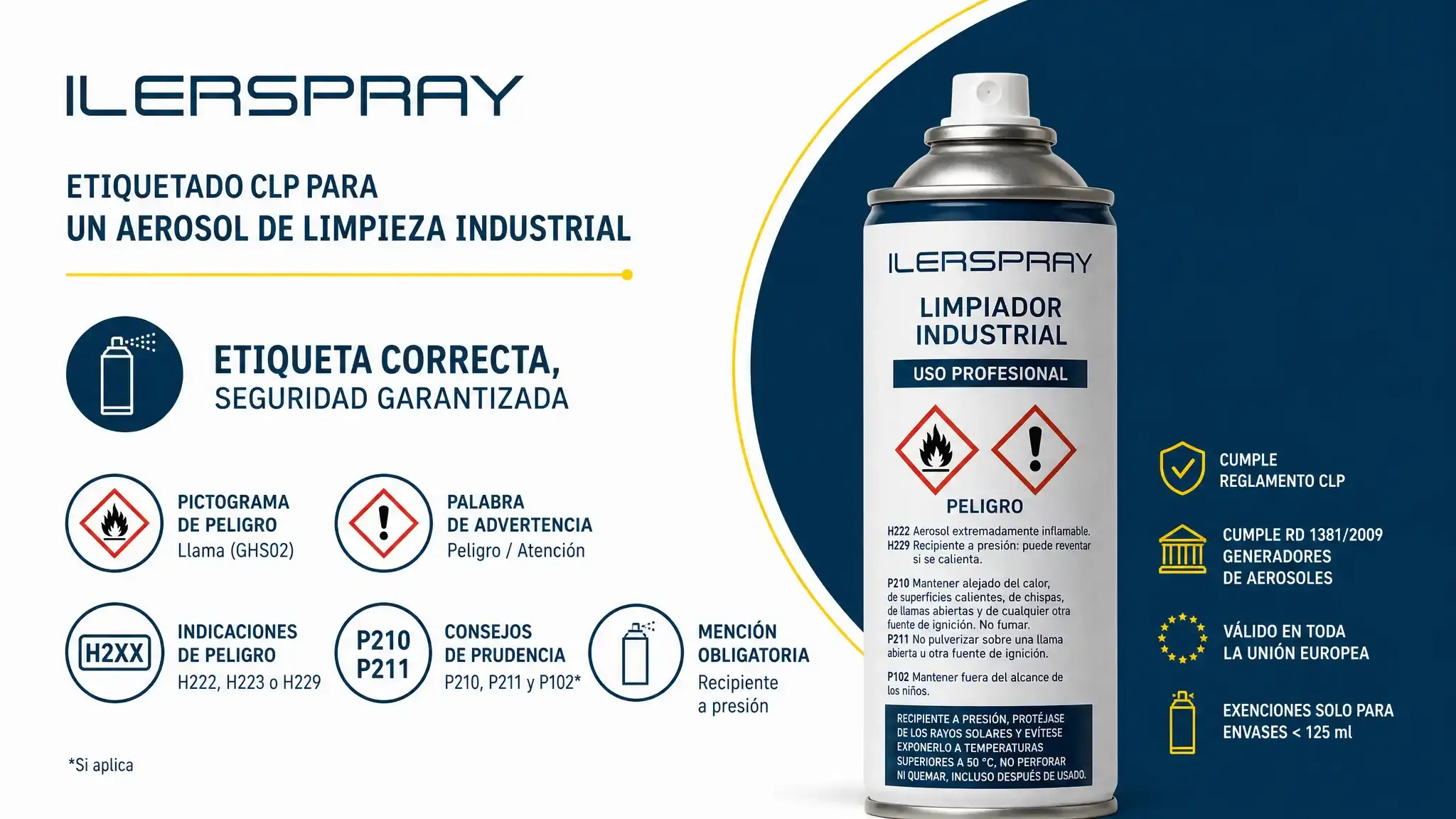
Regarding signage, the standard requires all storage areas and cabinets to carry clearly visible signs with the indication "Flammable" or other CLP pictograms corresponding to the product's H-phrases. Container labeling must be legible and updated according to current regulations.
The maintenance plan must include periodic checks of: sufficient lighting, correct state of the electrical installation, cleaning of natural ventilation outlets and, in the case of forced ventilation, verification of its operation.
📏 Safety Distances and Fire Protection
APQ-10 must be read in conjunction with the Fire Safety Regulation for Industrial Buildings (RSCIEI), approved by RD 2267/2004. Passive and active fire protection measures must be consistent between both regulations.
Depending on the storage category, specific safety distances must be maintained regarding public roads, inhabited or third-party buildings, activities with fire or explosion risk, and internal warehouse services. ATEX zone classification is mandatory for warehouses with flammable products.
The standard expressly prohibits the storage of certain products in below-ground levels. Furthermore, evacuation routes cannot exceed 25 meters to a safe exit route, a requirement that conditions the design of many warehouses.
🪣 Use of Cages and Storage in Industrial Warehouses
For flammable aerosols stored inside buildings without their own fire sector, APQ-10 contemplates the use of type 90 certified safety cabinets according to the UNE-EN 14470-1 standard. These cabinets offer the same passive protection characteristics as an independent fire sector.
The maximum storable quantity in a protected cabinet is 500 liters. In the case of storing products with H220 or H221 indications (flammable gases), ventilation to the outside of the cabinet is mandatory. Cabinets must display the "Flammable" sign and a 34A 144B efficiency fire extinguisher must be available in the vicinity.
In industrial warehouses with large volumes, storage can be carried out in areas segregated by sectorization, either through physical separation, distances between pallets, or through approved modular containers. Access to storage areas must be restricted.
🗓️ What Periodic Inspections Are Mandatory for Storage?
APQ-10 requires a documented maintenance plan with periodic reviews of all safety systems. Facilities must be inspected by an Authorized Control Body (OCH), such as TÜV SÜD, Bureau Veritas, or equivalent entities accredited by ENAC.
The frequency of inspections varies according to the type of installation, but generally, inspections every 5 years are established from the registration of the APQ warehouse in the corresponding autonomous community's registry. Additionally, more frequent internal level A (daily or weekly) and level B (annual or biennial) checks are performed.
Items inspected include: condition of personal protective equipment, spill containment systems, shelf stability and load capacity compliance, ventilation status, and adequacy of signage.
🧪 Can Aerosols and Flammable Liquids Be Stored Together?
This is one of the most frequent questions in mixed warehouses. The answer is: it depends on their H-phrases and the sectorization measures adopted.
APQ-10 establishes that flammable or combustible liquids cannot be stored in the same area as oxidizing products nor with non-combustible toxics, unless they are sectorized using safety cabinets. Corrosive products in fragile containers also cannot be located next to flammables without adequate separation measures.
For the specific case of flammable aerosols next to flammable liquids, the standard allows coexistence under segregation conditions: separation by construction, large distances, separate collection sumps, or protected cabinets. The classification of incompatibilities is done by consulting the joint storage table in Article 20 of ITC APQ-10.
🛒 Aerosol Management in Retail Stores and Laboratories
Retail stores and laboratories are not exempt from APQ regulations. APQ-10 also applies in warehouses of commercial establishments that are not open to the general public, which includes backrooms and distribution warehouses.
However, the standard provides for exceptions for quantities below certain thresholds. Containers in immediate use within production processes fall outside the scope of application, as do substances not classified as hazardous according to the CLP.
In laboratories, the standard requires special attention to ventilation at transfer points, separation of incompatibles, and restricted access. Mandatory documentation includes safety data sheets for all products and an updated record of the maximum inventory.
"In practice, many companies fail for small reasons: accumulation outside designated areas, lack of segregation by compatibility, or absence of evidence of training." — Ilerspray, Aerosol Regulatory Guide 2026
🏭 Ilerspray: Aerosol Manufacturer with Integrated Regulatory Management
Ilerspray is a Spanish aerosol manufacturer based in Torres de Segre (Lleida), specializing in contract manufacturing, private label, and own formulation for the industrial, automotive, and cosmetic sectors. Its plant operates under ISO 9001:2015 and ISO 22716:2017 certifications, with storage and production processes adapted to comply with RD 656/2017 and ITC MIE APQ-10. An additional guarantee for clients and partners who need to work with a manufacturer that knows and applies current regulations.