Five Criteria Separate a Good Aerosol Manufacturer from the Rest
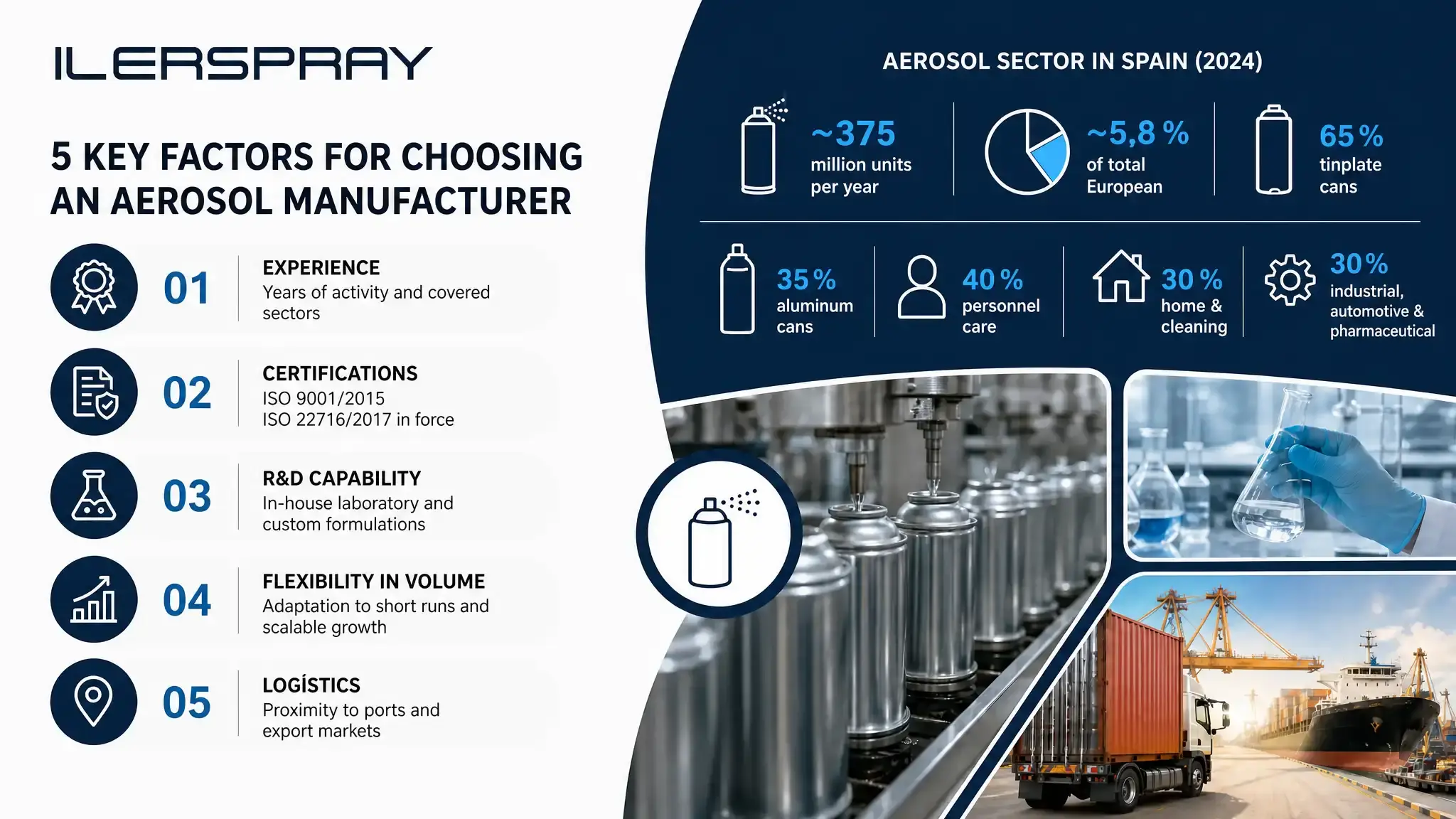
An aerosol manufacturer should be chosen on five criteria, not on unit price: current certifications whose scope covers your product, an in-house formulation lab, batch sizes that fit your launch, the ability to prepare the regulatory documentation, and logistics that suit your markets. Price only compares fairly between manufacturers that already meet all five.
The Spanish Aerosol Sector in Figures
Spain filled about 375 million aerosols in 2024, according to the AEDA annual production report. The split by use explains why specialisation matters: not every manufacturer covers a deodorant, an insecticide and an industrial lubricant with the same technical depth.
- Production in Spain (2024)
- 375 million units
- Study margin
- ±2 %
- Household
- 40 % of cans
- Personal care
- 29 %
- Other (industrial, technical)
- 29 %
Within household, insecticides account for more than 43 % of the segment, and in personal care deodorants are the largest part. The first filter is therefore simple: the manufacturer should already produce in your segment.
What Certifications Should an Aerosol Manufacturer Hold?
Certifications are audited proof that the manufacturer runs a documented quality system. ISO 9001 certifies quality management across the whole process: traceability, control of non-conformities and continuous improvement. ISO 22716 sets good manufacturing practice for cosmetics and is the reference for any personal care aerosol.
A manufacturer working across segments needs both. For a technical or household product ISO 9001 is in practice enough; for cosmetics, ISO 22716 is not optional.
💡 Technical tip: ask for the current certificates with the date of the last audit, and read the scope. An ISO 22716 certificate that does not include aerosols does not cover your spray deodorant.
The Five Criteria, One by One
Each criterion has a clear warning sign. Checking them in order saves visits to manufacturers that cannot make your product.
| Criterion | What to check | Warning sign |
|---|---|---|
| Certifications | Current ISO 9001; ISO 22716 for cosmetics | Expired certificate or partial scope |
| In-house lab | Formulation and validation of customer formulas | Only fills what it is given |
| Batches and lead times | Batches sized for a launch, committed lead time | Minimums that do not fit your plan |
| Documentation | Technical sheet, safety data sheet, registration if needed | The paperwork is left to you |
| Logistics | Distance to ports and to your markets | Plant far from your sales routes |
Experience matters, but it is measured within the segment: a team that has spent years formulating lubricants is not necessarily strong in cosmetics, and vice versa.
Does It Formulate or Only Fill?
This is the question that most separates two manufacturers that look alike. A filler fills the formula you hand over; a manufacturer with a lab can develop it, adapt it to the can and the propellant, and check before production that it stays stable under pressure.
That validation is what prevents surprises in the first batch: can corrosion, a valve that clogs, or a spray pattern that differs from the sample. If your project starts from scratch, a manufacturer without a lab sends you looking for the formula elsewhere.
Questions to Ask Before You Sign
Before asking for a price, these answers tell you whether the manufacturer fits your project:
- What exactly does the scope of its certificates include?
- Does it run batches the size of your first order, and with what lead time?
- Does it prepare the safety data sheet, the regulatory labelling and any registration your product needs?
- Will it sign a non-disclosure agreement before receiving your formula?
- How does it deliver: ex works, or with logistics coordinated to destination?
To check these answers against our own case, our aerosol contract manufacturing page sets out certifications, formats, propellants, lead times and batch sizes.