Back to blog
Articles

The Complete Aerosol Manufacturing Process: From Formulation to Final Product

The Complete Aerosol Manufacturing Process: From Formulation to Final Product

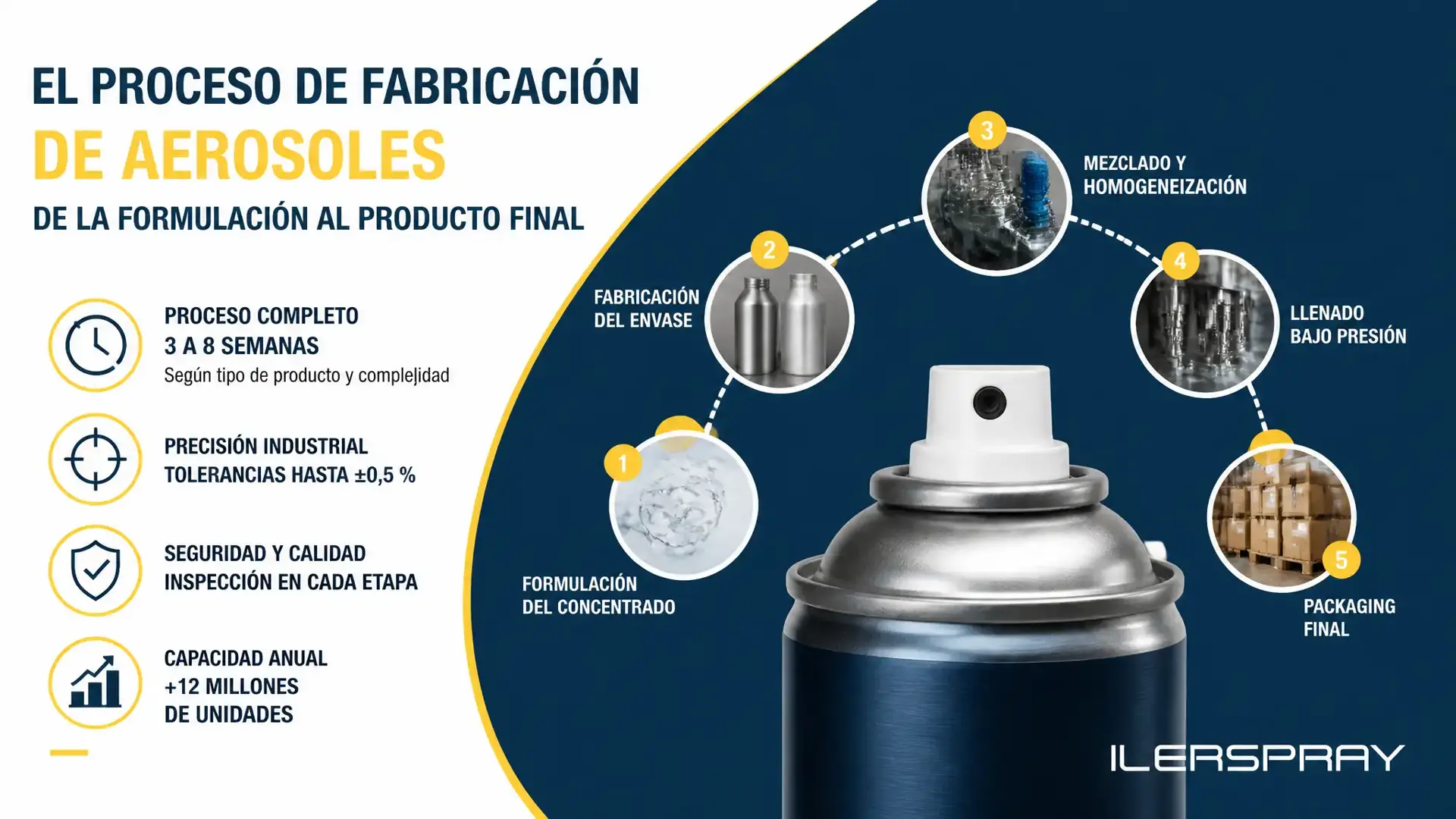
Aerosol manufacturing is a complex industrial process that combines advanced chemistry, precision engineering, and cutting-edge technology. Every aerosol that reaches the market has passed through five critical stages that determine its quality, safety, and efficacy. From initial formulation to final packaging, each step requires rigorous control and specialized technical expertise.

The complete process can take between 3-8 weeks depending on the type of product and the complexity of the formulation.

"When a product is developed, we must take many stages into account, and each stage has its time. If we want to deliver an optimal product to the market, we have to fulfill most of these stages" - Eng. Humberto Uc, aerosol development specialist at Envatec

In this detailed technical analysis, we break down each stage of the manufacturing process, from R&D laboratories to automated production lines, revealing the industrial secrets that make the products we use daily possible.

🧪 Formulation: The Brain of the Aerosol

The aerosol formulation is where the magic is born. This stage determines 80% of the final product's success. Here, not only efficacy is defined, but also stability, shelf life, and compatibility with different packaging materials.

"An aerosol system consists of liquid and gaseous phases. The type of container, valve, actuator, formula, type, and propellant pressure must be combined" - Eng. Humberto Uc, Envatec

Selection of Active Ingredients

Active ingredients are the functional heart of the aerosol. In deodorants, they can be aluminum compounds for antiperspirants or essential oils for fragrances. In insecticides, pyrethroids like permethrin are used to act against multiple insect species. For spray paints, the main ingredients include specific resins, pigments, and solvents.

The typical concentration of active ingredients varies from 0.5% in some cosmetics to 25% in technical products. Professional formulators use specialized software to model chemical interactions before physical testing.

Solvent Systems and Vehicles

Solvents dissolve the active ingredients and ensure homogeneous distribution. Alcohols are common in cosmetics, while hydrocarbons are used in technical products. Water acts as the main vehicle in many modern ecological formulations.

Technical note: The choice of solvent system directly affects the evaporation rate, the spray pattern, and the tactile sensation of the final product.

Stabilizers and Preservatives

Stabilizers prevent the degradation of active ingredients and extend shelf life. Preservatives are critical in water-based formulations to prevent microbial growth. These components typically represent 1-3% of the total formulation but are essential for product safety.

Emulsifiers and Rheological Modifiers

In formulations that combine aqueous and oily phases, emulsifiers maintain stability. Rheological modifiers control viscosity and flow behavior, critical aspects for obtaining the desired spray pattern.

🏭 Can Manufacturing: The Engineering of the Container

Aerosol cans are engineering masterpieces that must withstand pressures of 2-8 bar while maintaining minimum weight and maximum strength. 65% are tinplate and 35% are aluminum according to industry manufacturer statistics.

Aluminum Can Production

The manufacturing of aerosol cans consists of 3 stages:

1. Impact Extrusion: An aluminum alloy disc from the 3000 series is placed in a hydraulic press. A ram pierces the center, creating a deep cylinder in a single operation. This process allows speeds of up to 180 strokes per minute.

2. Shaping and Profiling: The cylinder passes through multiple shaping stations where the diameter is adjusted and the shoulder profile is created. Advanced technology uses more than 30 different extruder nozzles to achieve the exact geometry.

3. Heat Treatment: The cans pass through controlled ovens to cure internal lacquers and external coatings. The temperature must be maintained between 180-220°C for specific times to guarantee adhesion and durability.

Tinplate Can Production

Three-piece cans dominate the technical and industrial market. The process begins by cutting tin-plated steel sheets that are formed cylindrically and welded. The bottoms and tops are stamped separately and joined by double seaming, a process that guarantees absolute airtightness.

Technical fact: A typical aerosol can weighs between 45-85 grams but can withstand internal pressures of up to 12 bar.

Protective Coatings and Lacquers

Internal lacquers prevent corrosion and reactions between the product and the metal. Epoxy-phenolic lacquers are standard for aqueous products, while polyester lacquers are used for aggressive solvents. The typical thickness is 5-15 microns applied by electrostatic spraying.

Decoration and Printing

Offset printing allows up to 6 colors with photographic quality. The inks must be compatible with subsequent filling processes and resist internal pressure. The final varnish protects the decoration and provides the desired finish (matte, glossy, textured).

⚗️ Concentrate Manufacturing: Chemistry in Action

The aerosol concentrate manufacturing stage transforms individual raw materials into homogeneous formulations ready for packaging. Precision in this process determines batch-to-batch consistency and the quality of the final product.

Mixing and Homogenization

High-shear industrial mixers operate at 3,000-10,000 RPM to ensure perfect dispersion. For emulsions, high-pressure homogenizers are used that force the mixture through valves at pressures of up to 500 bar, creating uniform droplets of 0.1-2 microns.

Mixing time varies from 30 minutes for simple products to 4 hours for complex formulations. Automated systems control temperature, speed, and addition sequence for optimal reproducibility.

Temperature and Atmosphere Control

Many formulations require strict thermal control. Heat-sensitive ingredients are processed under 25°C, while some resins require heating up to 80°C. Processing tanks include heating/cooling systems with coils or water jackets.

"It is important to maintain all proper safety conditions during product development, using the appropriate laboratory equipment and personal protective equipment" - Eng. Humberto Uc, product development specialist

Critical Process: In controlled environments, relative humidity is maintained at <50% and particle concentration is limited to <100,000 particles/m³ to avoid contamination.

Filtration and Clarification

Liquid products pass through multi-layer filtration systems. Primary filters (25-50 microns) remove coarse particles, while final filters (0.2-1 micron) guarantee optical clarity and eliminate potential microorganisms.

In-Process Quality Control

Each batch is analyzed at multiple points: pH, viscosity, density, solid content, and stability. Inline analyzers monitor critical parameters continuously. Samples are subjected to accelerated aging tests to predict long-term stability.

🔧 Filling: Precision Under Pressure

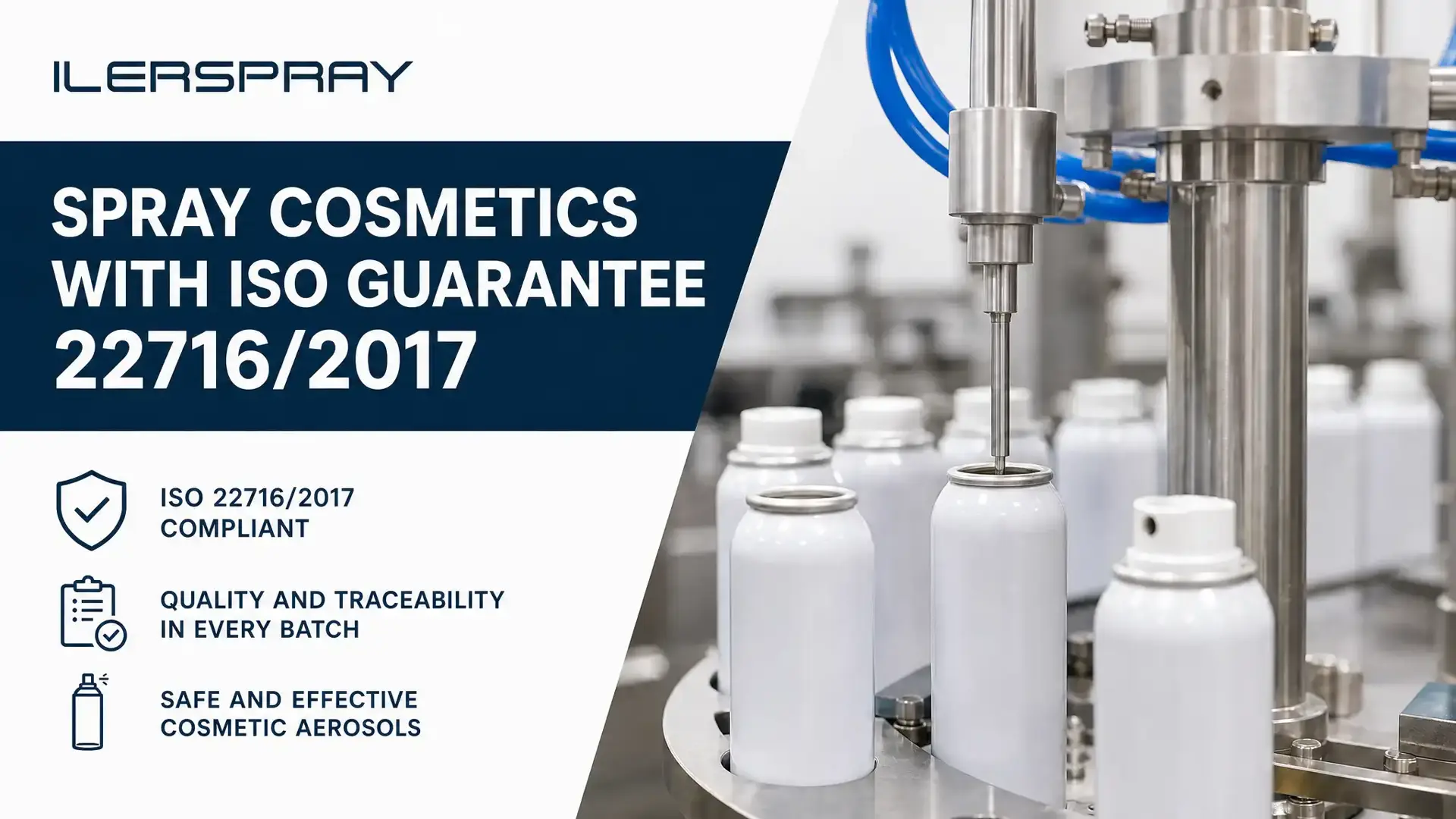
The aerosol filling requires specialized technology that simultaneously handles liquids, pressurized gases, and strict safety procedures. Modern lines reach speeds of 600-1,200 units per minute.

Can Preparation and Cleaning

Empty cans pass through cleaning stations that remove manufacturing residues, dust, and particles. Systems include blowing with filtered compressed air, residue suction, and, for sensitive products, washing with solvents or steam.

Automatic inspection detects defects such as dents, scratches, or welding residues. Defective cans are automatically rejected before filling to avoid product loss and maintain quality.

Base Product Dosing

Volumetric fillers use piston or pump systems to dose the product with ±0.5% precision. Filling heads are inserted into the can creating a temporary seal while the liquid is transferred. Weight is continuously verified to detect variations.

Technical aspect: In products containing particles (such as paints), stainless steel mixing balls are added before filling to facilitate homogenization during use.

Valve Placement and Seaming

Valves are automatically positioned and seamed to the can using high-precision machines. Seaming creates a hermetic seal capable of maintaining pressure for years. Seaming force is specifically calibrated for each valve-can combination.

Machine vision systems verify the correct position of valves and detect seaming defects. Defective valves are rejected before propellant injection to avoid dangerous leaks.

Propellant Injection

This is the most critical stage of the process. The propellant is injected through the valve under controlled pressure and temperature conditions. Modern systems use mass flow measurement to dose exactly the required amount of gas.

Injection can be performed by two methods: cold filling (propellant and product at -18°C) or under-the-cup injection (propellant at ambient pressure). Each method has specific advantages depending on the type of product and propellant used.

"Particle size is very important because it gives us the final characteristic of the product. The type of container, valve, actuator, formula, type, and propellant pressure must be combined" - Spanish Aerosol Association (AEDA)

Leak Testing

Each aerosol is subjected to leak testing using ultrasonic detectors or water immersion. Units showing microscopic leaks are automatically detected and rejected. This stage is crucial for product safety and quality.

📦 Packaging: The Final Presentation

The aerosol labeling and final packaging protects the product during transport and creates the user experience. Automated systems process thousands of units per hour while maintaining rigorous quality standards.

Actuator and Cap Assembly

Actuators are automatically assembled onto the valves, verifying correct fit and the functionality of the activation mechanism. Protective caps are placed to prevent accidental activation during handling and transport. Functional testing systems verify that each actuator produces the specified spray pattern. Units that do not meet flow or pattern parameters are automatically rejected.

Coding and Traceability

Each aerosol receives unique codes including: manufacturing date, batch number, production line, and shift. This information allows complete traceability from raw materials to the final consumer. Laser or inkjet printing systems print machine- and human-readable codes. Codes are automatically verified to ensure readability and accuracy before final packaging.

Quality standard: Modern lines maintain defect rates <0.01% through continuous automated control.

Final Weighing and Control

Automatic scales verify the total weight of each unit with ±0.1g precision. This control detects incorrect fillings, minor leaks, or assembly problems. Out-of-specification units are rejected and analyzed to identify causes.

Packing and Palletizing

Aerosols are packed in boxes designed to protect during transport. Automatic palletizing systems create stable pallets optimized for different modes of transport. Pallets are wrapped and labeled with complete logistics information.

🏆 Ilerspray: Technical Leadership in Spain

Ilerspray represents technical excellence as an aerosol manufacturer in Spain. From its facilities in Lleida, the company combines more than a decade of experience with cutting-edge technology to offer comprehensive manufacturing solutions.

With three fully automated aerosol packaging lines and tank capacity up to 35,000 liters, Ilerspray handles projects from pilot batches of 5,000 units to massive annual productions of millions of aerosols. Its facilities include R&D laboratories, clean rooms for sensitive products, and PLC control systems that guarantee batch-to-batch reproducibility.

"Despite our youth, we have a highly experienced team in aerosol formulation and filling, offering effective and safe products that meet the strictest quality standards" - Ilerspray

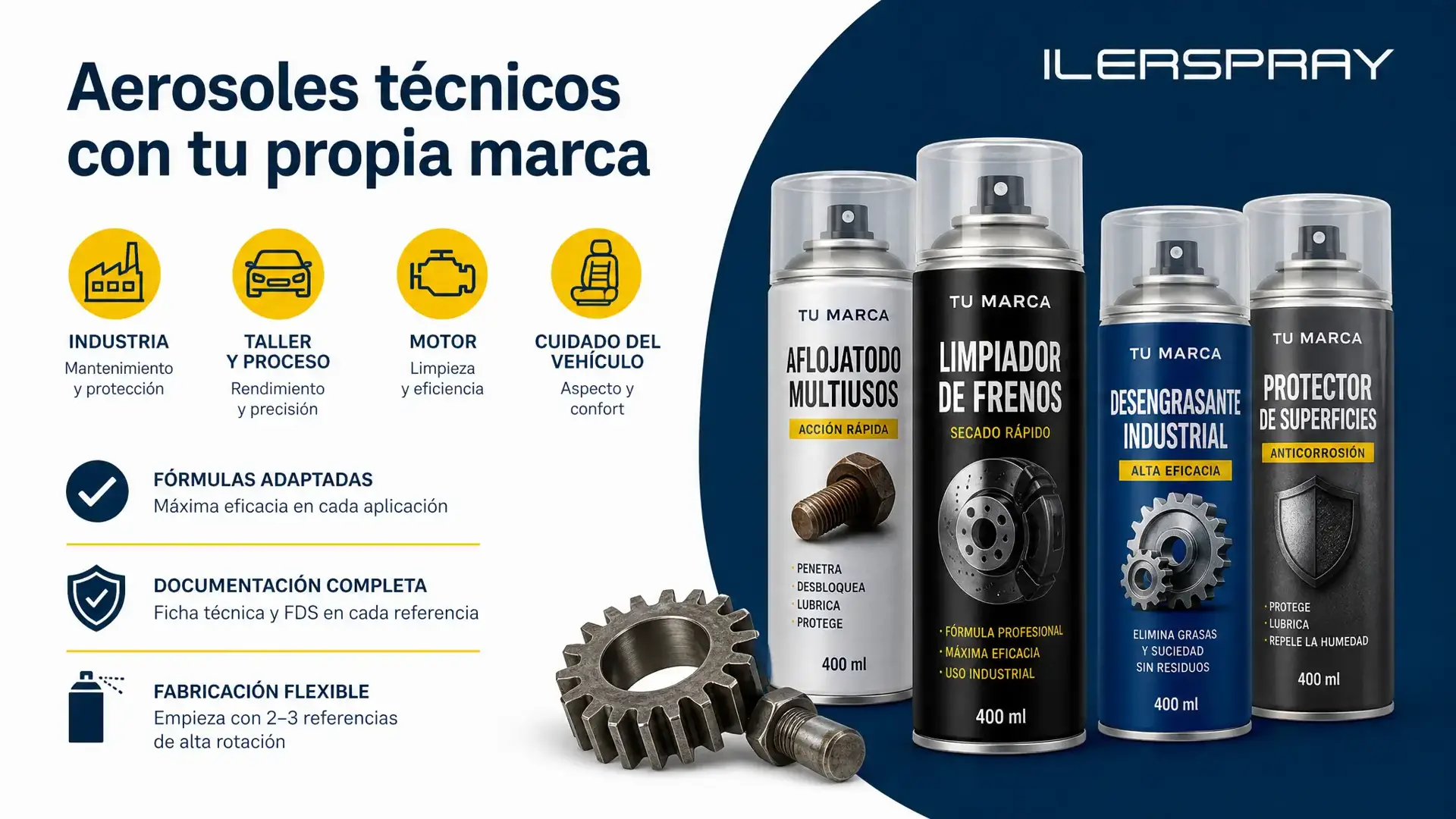
The company distinguishes itself by its comprehensive development capacity: from chemical formulation to packaging design, including process optimization and regulatory compliance. Its own brands APP (cosmetics and home) and Le-Brill (automotive and industrial) demonstrate the technical and commercial versatility of its manufacturing capabilities.

As a strategic partner, Ilerspray does not just manufacture aerosols; it develops complete solutions that allow entrepreneurs and established companies to create differentiated products with international quality and safety standards.

Aerosol manufacturing combines science, engineering, and industrial art. Each stage requires specific expertise and rigorous control to create products that meet performance, safety, and quality expectations. From molecular formulation to final packaging, this industrialized process allows innovations developed in the laboratory to reach millions of consumers worldwide.

The future of the industry points towards greater automation, environmental sustainability, and product personalization. Companies that master these complex processes, such as Ilerspray, are positioned to lead the next evolution of this fascinating and constantly growing industry.

"The quality of an aerosol is decided in the formulation. Filling only executes it — or betrays it."

— Ilerspray technical team

Ready when you are

Do you have a project in mind?

Contract manufacturing, private label, distribution, or a technical question. Write to us and we will respond with real industrial expertise.