Technical Aerosols Can Be Made Under Your Own Brand Too
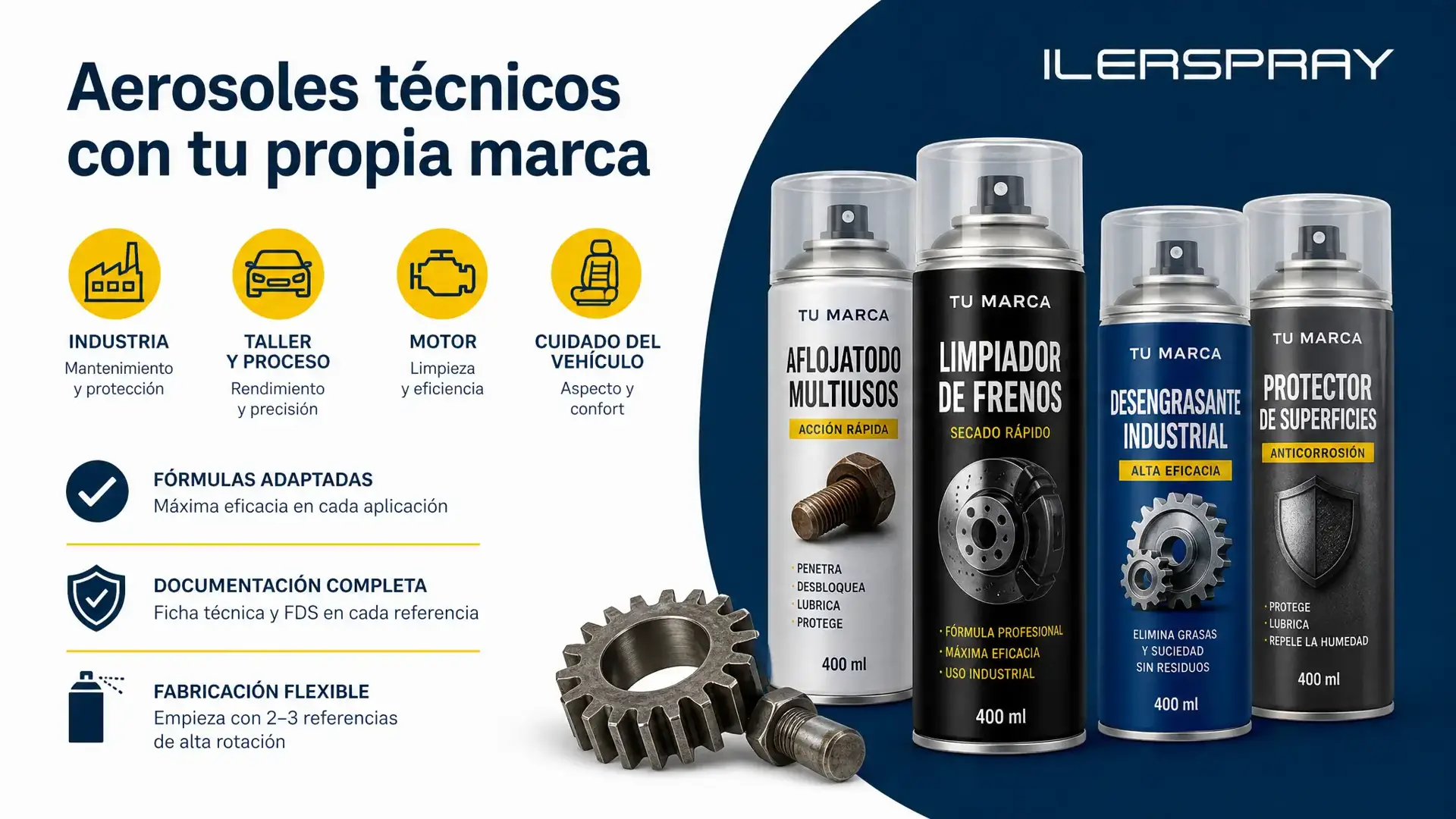
Degreasers, lubricants, penetrating oils, brake cleaners and protective sprays are made under the brand of an industrial distributor or a workshop network through contract manufacturing. The manufacturer formulates or adapts each product, fills it in aluminium or tinplate, and delivers a technical data sheet and a safety data sheet with every item.
Which Technical Aerosols Can Be Made Under Your Own Brand?
The technical families are the same ones Ilerspray makes for its Le-Brill Industry and Le-Brill Auto brands, and any of them can carry the distributor's brand:
| Use | Families |
|---|---|
| Industry | Degreasers and rust removers, multi-purpose and penetrating oils, greases and lubricants, surface protectors |
| Workshop and process | Anti-spatter for welding, release agents, chain lubricants |
| Engine | Engine, brake and carburettor cleaners, fuel and starting additives |
| Vehicle care | Bodywork, wheels and glass, dashboards and upholstery |
The formula is adjusted to real use: a workshop product works on hot or freshly stopped metal and must leave no residue near electrical parts, while a household one puts smell and handling first.
How Many Items Should You Start With?
Two or three high-turnover items, not the whole range. The products your customers already buy unbranded are the ones that validate your own brand fastest, and starting small keeps the initial investment in stock and label design low.
Expanding later is simple: same can, same base design, and a new data sheet per product. We work with flexible batch sizes, so each item can start at the volume your sales network can move.
💡 Manufacturer's tip: before closing the range, ask for a compatibility test between the product, the can and the propellant for each item. An aggressive degreaser may need a different can material or internal coating.
The Food Industry Needs a Formula Validated for That Use
A cleaner or lubricant for a food plant is not the same product with a different label: it is formulated not to leave residue that could compromise the food. Regulation (EC) 852/2004 requires surfaces in contact with food to be well maintained and easy to clean and, where necessary, to disinfect.
That regulation does not certify an aerosol, but it sets what the plant must be able to justify in its cleaning plan. So in contract manufacturing for this use, it is worth agreeing in writing that the formula is validated specifically for food contact before series production.
The Documentation Travels with Every Item
Every technical aerosol ships with its safety data sheet, its technical data sheet and a compliant label. Spain's Royal Decree 1381/2009 requires the label to identify the person responsible for placing the product on the market, the batch and the net contents, and to carry the pressurised-container warning. If the mixture is classified as hazardous, the CLP Regulation adds pictograms and hazard statements.
That documentation is what your professional customers will ask you for, and the manufacturer prepares it.
To plan your technical range, our aerosol contract manufacturing page lists formats, propellants and the request form.