Your Spray Cosmetics Need an ISO 22716 Manufacturer
To make spray cosmetics under your own brand you need two things: a manufacturer that produces under the good manufacturing practices of ISO 22716, and a responsible person in the European Union who notifies the product before it is sold. The manufacturer formulates, fills and documents; the brand, as the responsible person, answers for the product on the market.
Which Spray Cosmetics Are Made for Other Brands?
Aerosols are used above all for personal care products applied without touching skin or hair with the hands: deodorants and antiperspirants, hairsprays and fixatives, mousses, dry shampoos, body sprays and hygiene products. In Spain, deodorants are the largest part of personal care aerosols.
| Family | Examples |
|---|---|
| Deodorants | Deodorant, antiperspirant, foot deodorant |
| Hair | Hairspray, fixative, mousse, dry shampoo |
| Body | Body sprays, mists, spray oils |
| Hygiene | Intimate hygiene, refreshing sprays |
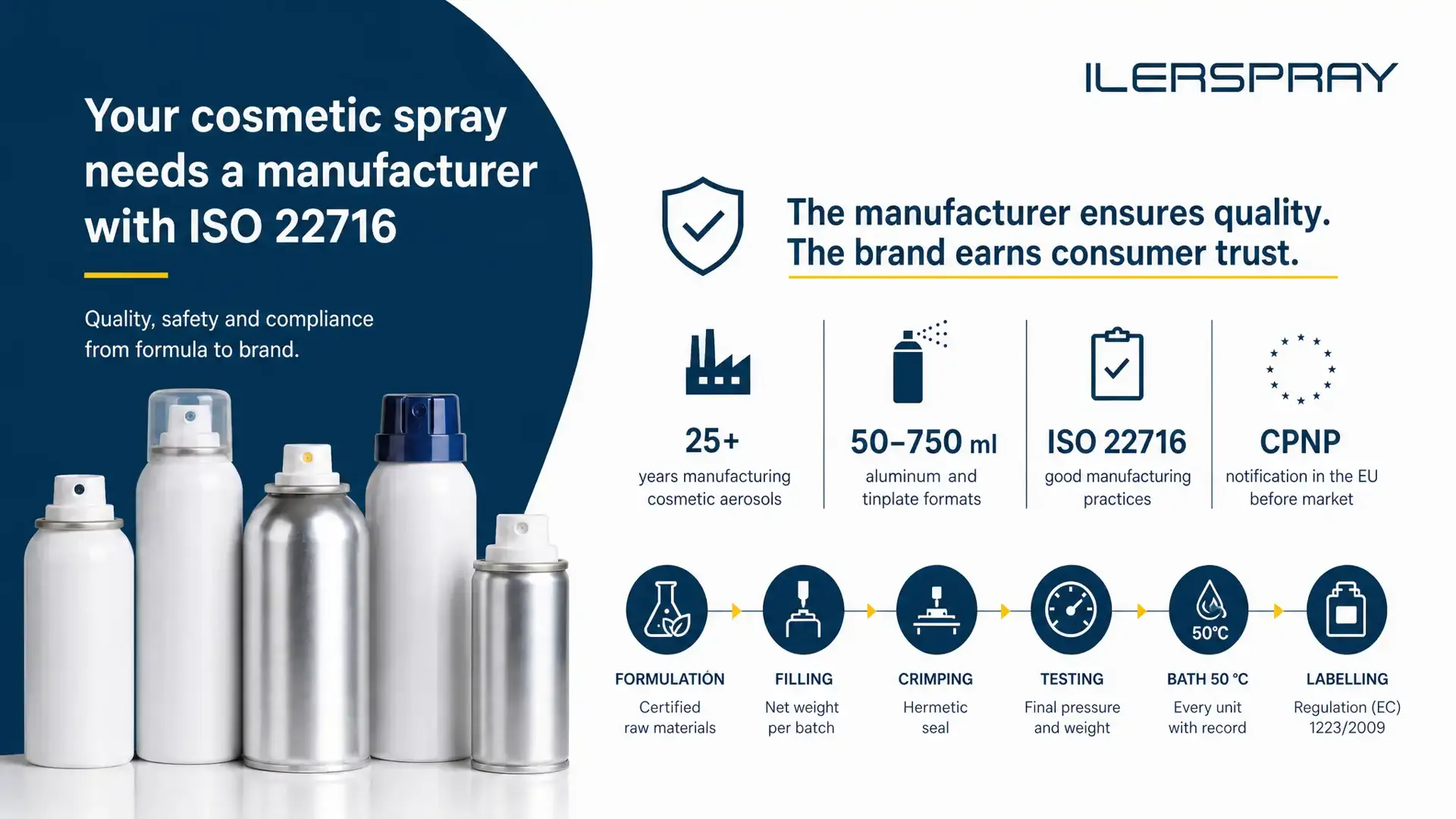
Ilerspray fills cosmetics in aluminium and tinplate cans from 50 to 750 ml, in the same plant that makes its own cosmetics line.
What Does ISO 22716 Require of the Manufacturer?
ISO 22716 is the good manufacturing practice standard for cosmetics. It requires documented, controlled manufacturing for everything that can affect the product: staff training, premises and equipment, raw material intake, production, quality control, and handling of deviations, complaints and recalls.
For a cosmetic aerosol this means written instructions for every batch, weight and leak-test records, and traceability from each raw material to the finished can. Ilerspray manufactures under ISO 22716.
💡 Technical tip: ask for the current ISO 22716 certificate and check that its scope includes aerosols, not just liquids or creams. The scope matters as much as the certificate.
What the Manufacturer Does and What the Responsible Person Does
Regulation (EC) 1223/2009 splits the obligations. The responsible person, established in the EU and usually the brand, notifies the product in the European Commission's CPNP portal before placing it on the market and keeps the product information file (PIF) with the safety assessment.
| Obligation | Who takes it on |
|---|---|
| Manufacturing to good practice (ISO 22716) | Manufacturer |
| Batch records and quality controls | Manufacturer |
| CPNP notification before sale | Responsible person |
| PIF and safety assessment | Responsible person, with the manufacturer's data |
| Compliant labelling (INCI, responsible person, batch) | Responsible person, applied by the manufacturer |
The PIF must be kept for ten years after the last batch is placed on the market, and much of its content comes from the documentation the manufacturer generates with every production run.
How a Cosmetic Aerosol Moves Through the Plant
A cosmetic aerosol follows the same process as any aerosol, with ISO 22716 controls at every step:
| Stage | Key control |
|---|---|
| Formulation | Raw materials with certificates of analysis |
| Filling | Net weight recorded per batch |
| Valve crimping | Tightness of the seal |
| Propellant injection | Pressure and final weight |
| 50 °C water bath | Every unit, with incidents recorded |
| Labelling | Mandatory information under Regulation 1223/2009 |
If you are preparing a spray cosmetics line, our aerosol contract manufacturing page lists formats, propellants and certifications, along with the form to send us your brief.