Quality and Safety Regulations in Aerosol Manufacturing: The Ultimate Guide for the Industry

The aerosol industry moves billions a year and is present in 75% of Spanish households. We are talking about a sector that produces more than 300 million units annually in Spain alone, positioning us in the European Top 6 of manufacturers. But behind every spray we use daily, there is a complex regulatory framework that guarantees its safety and quality.
From deodorants to the most specialized industrial products, all aerosols must comply with strict regulations covering everything from their manufacture to their transport for commercial distribution, storage, or disposal. A poorly designed container can explode, an unsuitable propellant can contaminate, and a faulty valve can cause serious accidents. Therefore, regulation is not optional: it is the barrier between a safe product and a potential disaster.
In this article, we will break down the main regulations governing this sector, from the European Aerosol Directive to specific ISO certifications, including mandatory safety tests and the latest updates in ADR transport. If you manufacture, package, or simply work with aerosols, this information is critical for your operation.
What does European regulation say about aerosols?
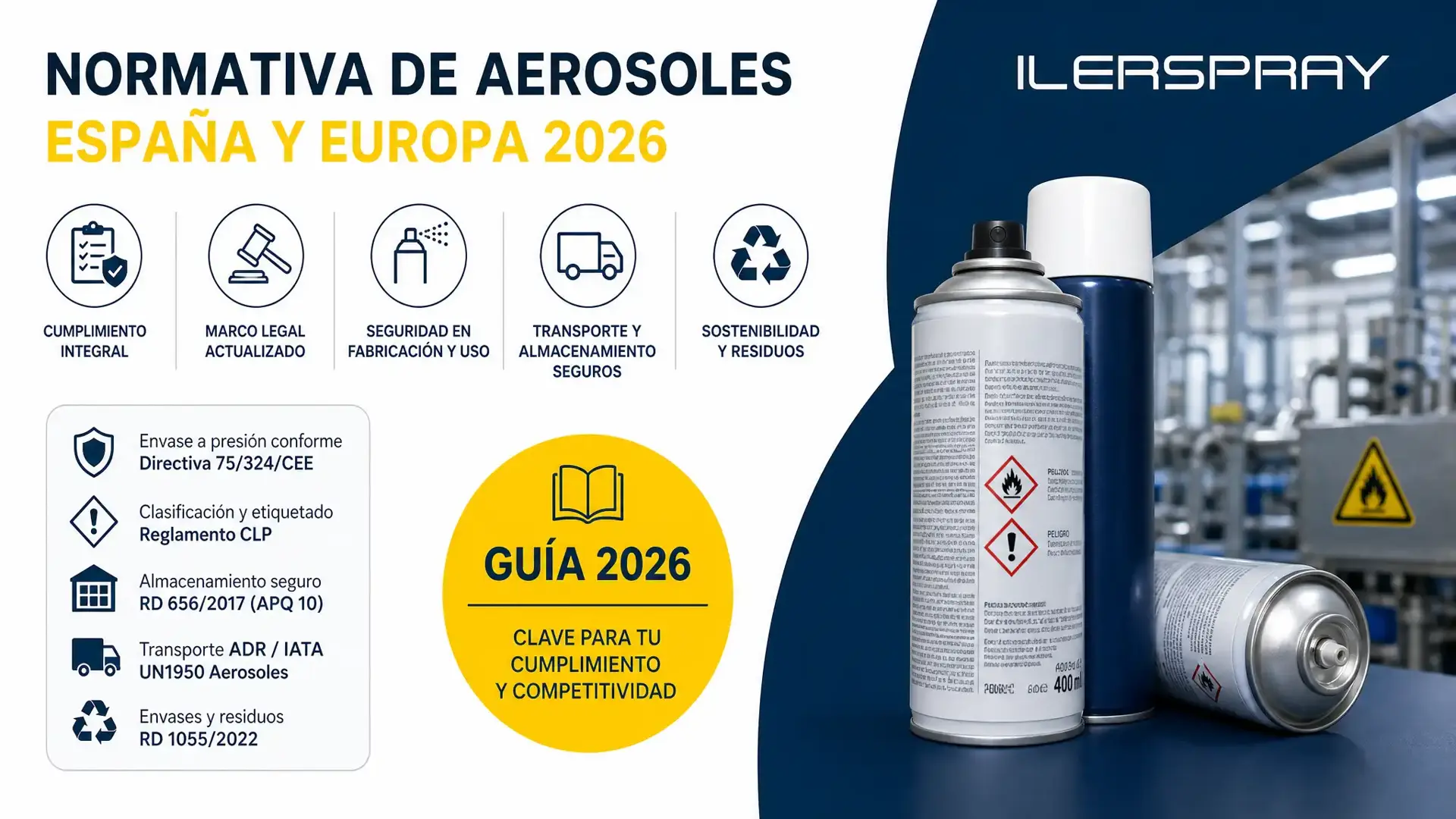
The Directive 75/324/EEC, last updated by Directive 2008/47/EC, is the cornerstone of aerosol regulation in Europe. This regulation, transposed into Spanish law by Royal Decree 1381/2009, establishes the fundamental requirements for the manufacture and marketing of aerosol dispensers.
The directive defines an aerosol as any non-refillable container made of metal, glass, or plastic, containing a compressed, liquefied, or dissolved gas under pressure, with or without liquid, paste, or powder. The container must be fitted with a release device allowing the contents to be ejected as solid or liquid particles in suspension in a gas.
A significant change introduced in the latest amendments is the acceptance of alternative inspection methods to the traditional hot water bath. Gas sensor detection systems and other technologies are now permitted, provided they guarantee the same level of safety. This represents an important advance in energy efficiency and sustainability for manufacturers.
ISO 22716: The Gold Standard for Aerosol Cosmetics
When talking about aerosol cosmetic products, the ISO 22716 standard becomes an essential reference. This standard provides guidelines for Good Manufacturing Practices (GMP) specific to the cosmetic industry, being voluntary but highly recommended by health authorities.
ISO 22716 covers the entire production process: from the reception of raw materials to the shipment of the finished product. It establishes requirements for personnel, facilities, equipment, documentation, and quality control systems. A crucial aspect is the full traceability of the product, allowing each batch to be tracked from its origin to the final consumer.
According to European Regulation 1223/2009 on cosmetic products, although ISO 22716 certification is not mandatory, compliance with GMP has been since July 2013. This means that manufacturers must demonstrate to authorities that they follow practices equivalent to those described in the standard, making it a de facto essential standard.
For companies looking to expand internationally, ISO 22716 certification is especially valuable. Countries like the United States and Canada, although they have their own regulations, recognize this standard as the basis for cosmetic GMP, facilitating entry into these markets.
How to Guarantee Safety with the Hot Water Bath Test?
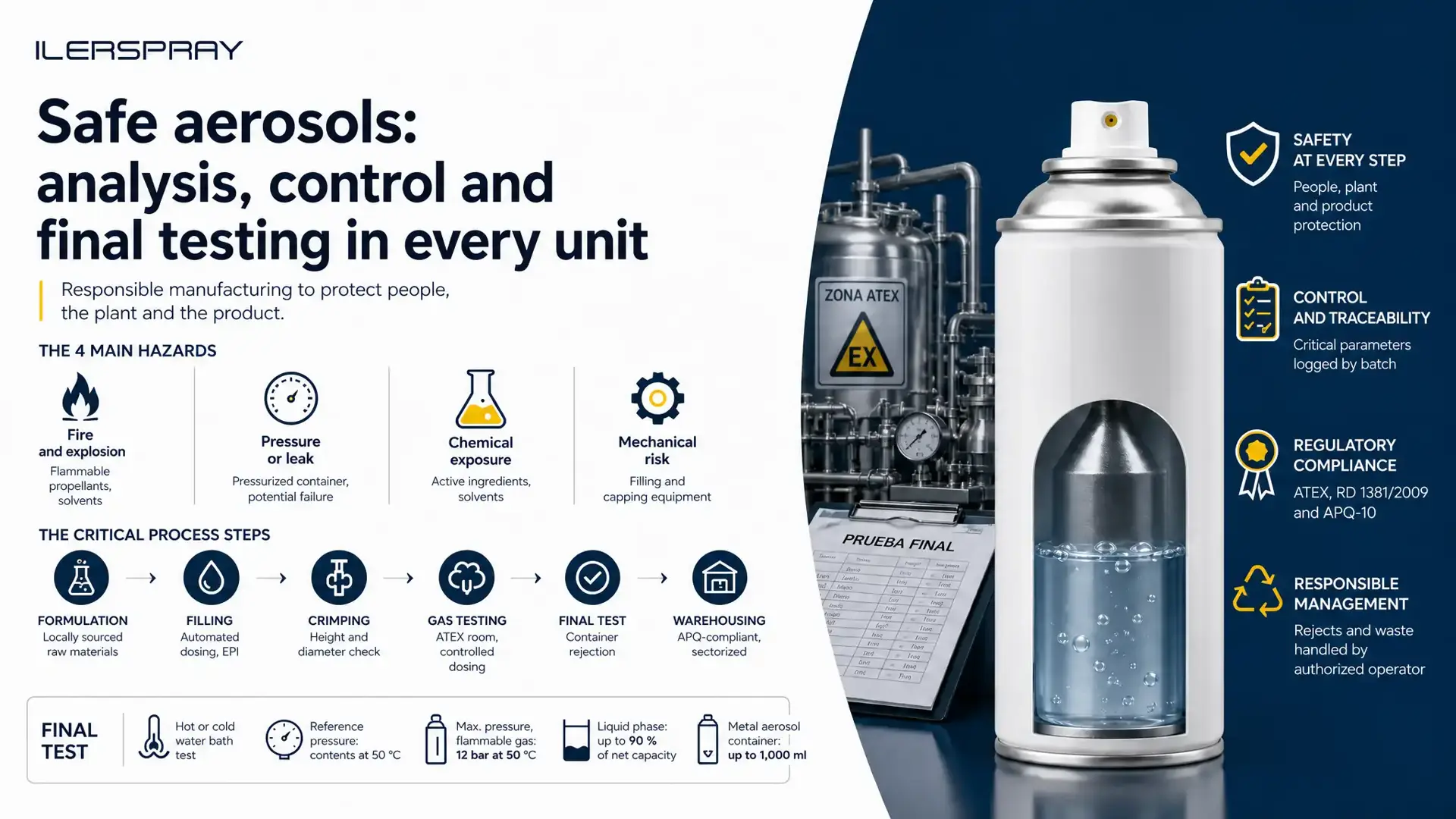
The hot water bath test is perhaps the most iconic test in aerosol manufacturing. It consists of immersing each aerosol in water at a temperature between 55 and 60°C for one to three minutes, until the internal pressure reaches the value it would have at 50°C.
This test, inherited from the industry's beginnings in 1947, simultaneously verifies several critical aspects: container airtightness, pressure resistance, correct filling, and the absence of deformations. No leakage or permanent deformation should occur, except for plastic containers which may soften as long as they do not leak.
However, the traditional hot bath presents challenges. It consumes a lot of energy maintaining between 1000 and 1500 liters of water at high temperature, requires additional drying and ventilation systems, and has been the scene of serious accidents when temperature control fails. Therefore, the industry is adopting alternatives such as gas leak detection sensors, ultrasound systems, or differential pressure chambers.
According to FEA (European Aerosol Federation) recommendations and compliance with UN regulations, this test or its approved alternatives are mandatory for 100% of production. It is not a statistical sample: every single aerosol must be tested individually before leaving the factory.
ADR 2025: New Rules for Aerosol Transport
The ADR Agreement regulates the transport of dangerous goods by road, and aerosols are classified under Class 2 (gases). The latest updates for 2025 introduce significant changes that every manufacturer and carrier must know.
Aerosols are transported under UN number 1950, with different categories according to their flammability and toxicity. An important change is the progressive digitalization of documentation, allowing the use of electronic consignment notes that improve traceability and reduce administrative errors.
For transport in limited quantities (very common for aerosols), the limit remains 1000 points per transport unit, where each aerosol counts as 1, 2, or 0 points depending on its category. Packaging must be approved with the corresponding UN code, typically 4G for cardboard boxes or 4B for aluminum boxes.
Personnel training has also been reinforced. Drivers must renew their ADR certificate every 5 years, with special emphasis on emergency management. Involved companies must designate a Safety Adviser, a mandatory figure who supervises regulatory compliance and manages accident reports.
Which Quality Controls are Essential During Production?
Quality control in aerosols goes far beyond the airtightness test. It begins with the verification of raw materials: each batch of propellant must be analyzed by gas chromatography, and concentrates require tests for viscosity, pH, and moisture content.
During filling, weight control is critical. It must be checked at least every 20 minutes, maintaining detailed records. Overfilling can cause explosions, while underfilling affects product functionality. The typical tolerance is ±3% of the declared weight.
The crimping of the valve requires millimeter precision. The standard depth is 0.202 inches (5.13 mm) and the diameter is 27.10 mm ± 0.1 mm. These parameters are verified with specialized Boxal II type gauges, which measure contact height and detect sealing irregularities.
Functional tests include the spray pattern (shape and diameter of application), discharge rate (grams per second), and for flammable products, flame length. Each parameter has precise specifications that must be consistently met.
New Sustainable Packaging Requirements for 2025-2030
The Regulation (EU) 2025/40 on packaging and packaging waste introduces revolutionary changes that will directly impact the aerosol industry. From 2030, all packaging must be designed to reduce its volume and weight to the minimum necessary, prohibiting features whose sole purpose is to increase the perception of product volume.
Aerosol containers must incorporate minimum recycled content: 30% for aluminum containers and 50% for steel ones by 2030. Additionally, reuse targets are established which, although challenging for traditional aerosols, are driving the development of innovative refillable systems.
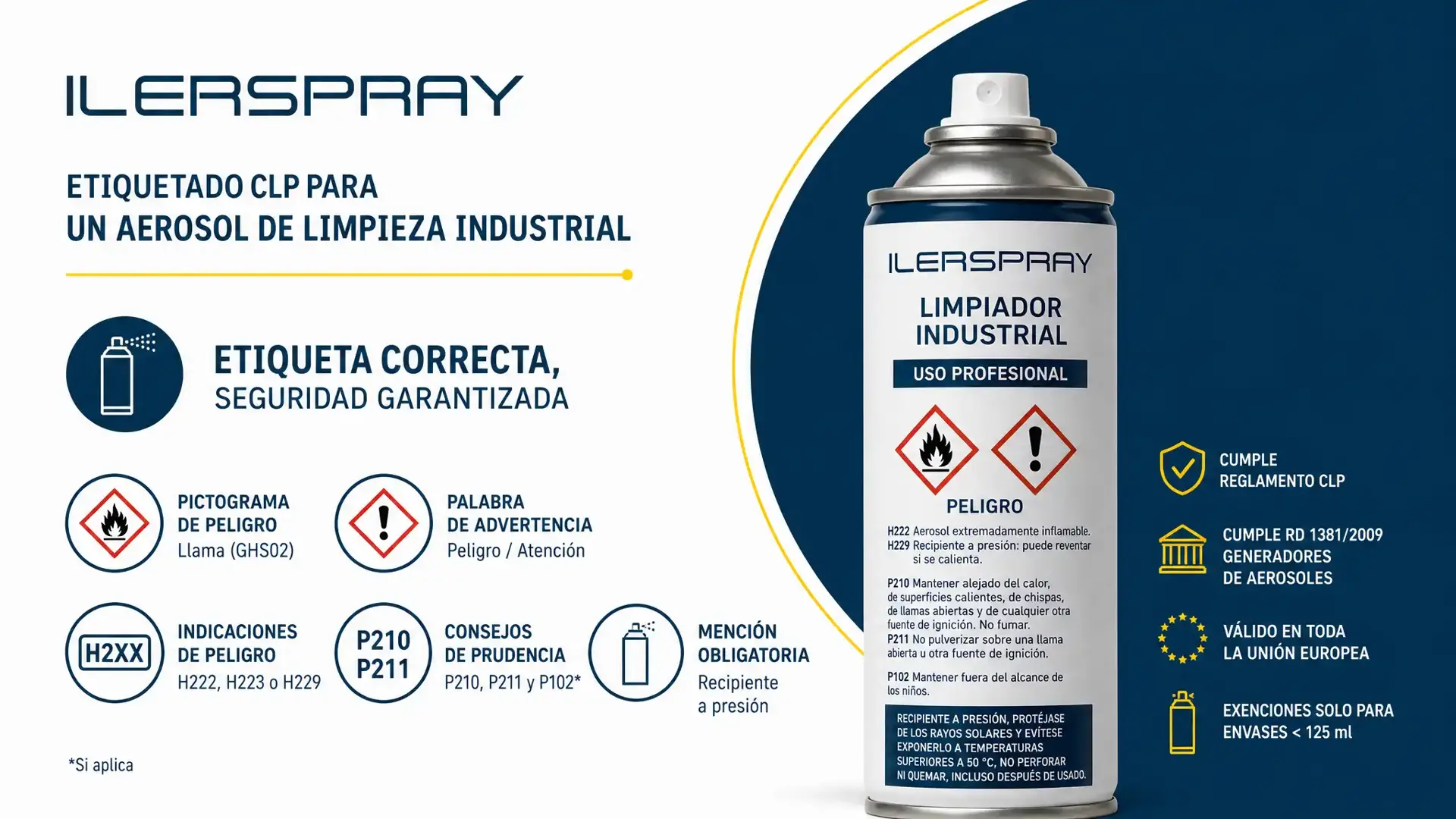
Labeling also changes substantially. It will be mandatory to include information on the composition of the packaging, instructions for separating components for recycling, and QR codes linking to expanded information on sustainability. Traditional flammability and pressure symbols remain, but new pictograms related to the circular economy are added.
Extended producer responsibility is intensified. Manufacturers must contribute financially to collection and recycling systems based on eco-design criteria. Packaging that is more difficult to recycle will pay higher fees, incentivizing innovation in materials and design.
How Does Air Quality Regulation Affect Propellants?
The Directive (EU) 2024/2881 on air quality establishes stricter limits for volatile organic compounds (VOCs) that directly affect the propellants used in aerosols. Traditional hydrocarbons like butane and propane are still permitted, but with increasing restrictions in specific applications.
Dimethyl ether (DME) is emerging as a preferred alternative due to its lower environmental impact, although it presents technical challenges in compatibility with gaskets and valves. Compressed gases like nitrogen and CO2 are gaining ground in applications where flammability is critical, although they require higher pressures and reinforced containers.
By 2027, an emission quota system for industrial VOCs is expected to come into force, which could significantly increase the cost of traditional propellants. This is accelerating research into next-generation propellants, including hydrofluoroolefins (HFO) with ultra-low global warming potential.
Companies must prepare for this change through gradual reformulations and exhaustive stability tests. A change in propellant can affect vapor pressure, spray pattern, product compatibility, and shelf life, requiring full product revalidation.
The Crucial Role of the ADR Safety Adviser
Every company that manufactures, fills, dispatches, or transports aerosols must designate one or more Safety Advisers according to Royal Decree 97/2014. This figure, often underestimated, is fundamental for regulatory compliance and accident prevention.
The Adviser must hold a valid certificate obtained after passing an official examination on dangerous goods. Their responsibilities include verifying compliance with regulations, advising the company on operations with dangerous goods, and preparing the mandatory annual report on the company's activities.
In the event of an accident involving personal injury, material, or environmental damage, the Adviser must prepare a detailed report within a maximum of 30 days. This report analyzes the causes, consequences, and corrective measures, being fundamental to avoid sanctions that can reach 800,000 euros.
The designation of the Adviser must be communicated to the competent authorities and renewed every 5 years. Many companies choose to outsource this service, but it is crucial that the Adviser has in-depth knowledge of the company's specific operations to be effective.
Technological Innovations in Quality Control
The industry is adopting Industry 4.0 technologies to improve quality control. Machine vision systems inspect 100% of containers, detecting microscopic defects in crimping that would escape traditional visual inspection.
IoT sensors monitor critical parameters in real-time such as test bath temperature, filling pressure, and environmental conditions. Data is stored in the cloud, allowing for full traceability and predictive analysis to prevent failures before they occur.
Infrared spectroscopy (FTIR) allows for instantaneous analysis of propellants and products without the need for destructive sampling. This is especially valuable for high-value products or small batches where traditional sampling represents a significant cost.
Ultrasound or helium leak detection systems offer alternatives to the hot bath with higher sensitivity and lower energy consumption. Although the initial investment is high, the return is achieved quickly through energy savings and higher production speeds.
Conclusion: Regulation as a Competitive Advantage
Aerosol regulations may seem overwhelming, but it is fundamental to understand them as a tool for competitive differentiation. Companies that go beyond mere compliance, adopting the best available practices, not only avoid sanctions but also build a reputation and open doors to new markets.
The future of the sector lies in sustainability, digitalization, and innovation in materials and processes. Current regulations already point in that direction, and companies that anticipate regulatory changes will be better positioned to lead the market in the coming years.
Safety and quality are not costs; they are investments. Every euro spent on regulatory compliance is one euro less in potential accidents, product recalls, or reputational damage. In an industry where consumer trust is fundamental, rigorous regulatory compliance is the foundation upon which to build a sustainable and prosperous business.
"The quality of an aerosol is decided in the formulation. Filling only executes it — or betrays it."