Requirements of Regulation 1223/2009 for Personal Care Aerosols

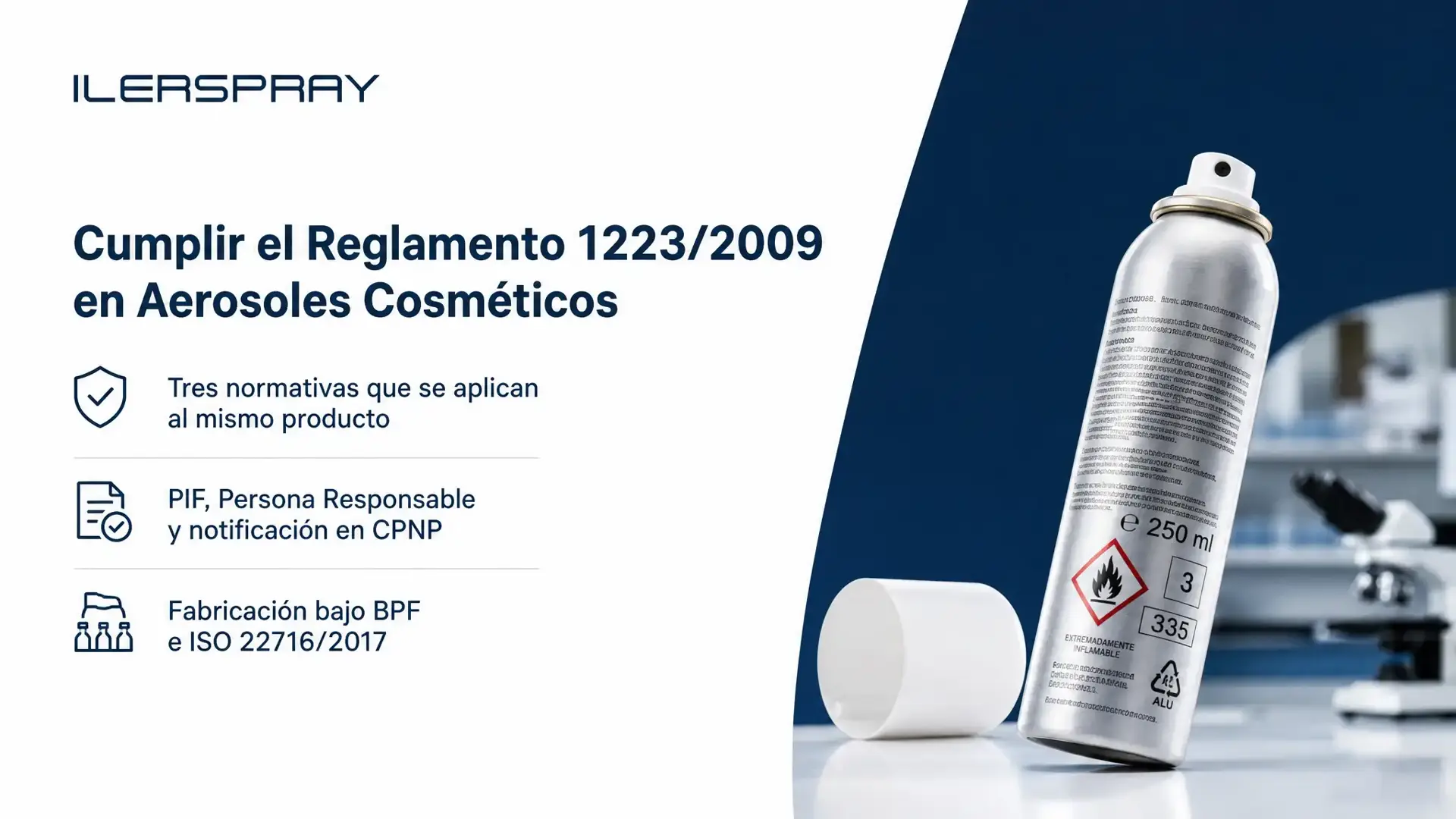
Every morning, millions of people start their day by pressing an aerosol without a second thought: deodorant after a shower, hairspray to set a style, spray sunscreen before heading out. Behind this everyday gesture lies one of the most demanding regulatory frameworks in the entire consumer goods industry. A cosmetic spray is not just a pleasant formula inside a can: it is, simultaneously, a cosmetic product and a pressure vessel, and this dual nature requires compliance with three legal bodies at once.
The centerpiece is Regulation (EC) 1223/2009 on cosmetic products, in force since July 11, 2013, and directly applicable in all 27 Member States. Revolving around it are the aerosol dispenser regulations and the CLP Regulation on classification and labeling. For a manufacturer, understanding how these pieces fit together is not a bureaucratic formality: it is the difference between launching a product with guarantees or risking a market withdrawal.
This guide walks through, step by step, what Regulation 1223/2009 requires of a personal care aerosol before it reaches the shelf, with concrete examples and official sources to delve deeper into each point.
Main Takeaways
The essentials of cosmetic aerosol regulations, summarized in five keys:
Why a Cosmetic Spray is Not Just Any Product
The Regulation defines a cosmetic product as any substance or mixture intended to be placed in contact with the external parts of the human body —skin, hair, nails, lips— or with the teeth and the mucous membranes of the oral cavity, with a view to cleaning them, perfuming them, protecting them, or improving their appearance. Put simply: if it goes on the body and its mission is to care for or beautify it, it is a cosmetic, whether it comes in a jar, a tube, or an aerosol.
This definition brings a long list of daily-use sprays directly under the Regulation. It is useful to have them identified, as it is not always obvious where the cosmetic ends and another category begins.
| Personal Care Aerosol | Is it a cosmetic? |
|---|---|
| Deodorant and antiperspirant spray | Yes |
| Hairspray, mousse, and hair setting spray | Yes |
| Sunscreen in spray format | Yes |
| Dry shampoo | Yes |
| Sprayable colognes and perfumes | Yes |
| Shaving foam and gel | Yes |
| Lubricant, contact cleaner, or degreaser spray | No — it is a technical aerosol |
The boundary matters. A lubricant spray and a deodorant may come off very similar filling lines, but the second enters the cosmetic field and the first does not. This distinction determines which file must be prepared, which authority monitors the product —in Spain, the Agencia Española de Medicamentos y Productos Sanitarios (AEMPS)— and what must appear on the label.
And here is the nuance that makes these products special: the cosmetic aerosol always wears two hats. As a cosmetic, it answers to Regulation 1223/2009. As a pressurized container, it answers to aerosol regulations and CLP. Neither exempts the other.
The Responsible Person: Who Takes Responsibility
If something goes wrong with a cosmetic —a skin reaction, incorrect labeling, a prohibited ingredient— the law wants to know who to turn to. That is the purpose of the Responsible Person, the figure that Article 4 of the Regulation places at the center of everything.
No cosmetic can be marketed in the EU without a designated Responsible Person established within the Union. It can be the manufacturer, the importer, or a third party commissioned for that role in writing, but they must always exist and must always be reachable within European territory.
Their responsibility is not symbolic. The Responsible Person ensures that the product is safe, that the file is complete and up to date, that the CPNP notification has been made, and that if a serious undesirable effect occurs, it is communicated to the authorities. Their name and address must appear on the container itself, so that anyone —a consumer, an inspector— knows who to contact.
To ensure safety, each cosmetic product placed on the market should be manufactured under the responsibility of an unequivocally designated legal or natural person.
For a manufacturer producing their own brand, it is common to assume this role directly. For those manufacturing for third parties, it is advisable to establish in writing, via contract, who acts as the Responsible Person for each reference. It is not a minor detail: it is the person the authority will call first.
Safety is Proven on Paper
A cosmetic aerosol can smell wonderful and work perfectly, but that is not enough. The law requires proof that it is safe, and this demonstration is made in writing before the first unit is sold.
The heart of this proof is the safety assessment, contained in a Cosmetic Product Safety Report according to Annex I of the Regulation. It cannot be signed by just anyone: it is signed by an assessor with accredited qualifications in pharmacy, toxicology, medicine, or an equivalent discipline. This expert analyzes the formula, the intended use, the target population, and actual exposure —including inhalation, a non-trivial factor when talking about a product sprayed into the air.
All this documentation lives within the Product Information File (PIF), regulated in Article 11. The PIF is the complete record of the product and must be kept available to the authorities at the address of the Responsible Person for ten years following the date on which the last batch was placed on the market. Ten years is a long time: it requires traceability and archiving that cannot be improvised.
| Requirement | Detail |
|---|---|
| Safety Report | Parts A (product data) and B (expert assessment), according to Annex I |
| Qualified Assessor | Degree in pharmacy, toxicology, medicine, or analogous discipline |
| Manufacturing Method | Description of the process and declaration of compliance with GMP |
| Stability and Microbiology Tests | Trials supporting the shelf life and safety of the product |
| PIF Retention | 10 years from the marketing of the last batch |
In practice, assembling the PIF for a cosmetic aerosol is a team effort between the laboratory that formulates, the assessor who signs, and the manufacturer who packages. The sooner they coordinate, the smoother the launch.
Notify Before Selling: The CPNP Portal
Having the file ready is not the last step. Article 13 mandates notification that the product is going to be placed on the market, and this notice is given through the Cosmetic Product Notification Portal (CPNP), the European Commission's free electronic platform.
The logic of the CPNP is twofold. On one hand, it informs authorities about which products are circulating and who backs them. On the other —and this is what many consumers do not know— it makes the frame formula available to poison centers, so that an emergency service can act quickly if someone suffers poisoning or a serious reaction.
The great advantage of the system is its unified nature: once a product has been notified in the CPNP, no additional notification is required at a national level within the EU. A single procedure opens all 27 markets. For aerosols, this notification is particularly relevant due to the common presence of flammable propellant gases, information that interests both toxicologists and emergency services.
Manufacturing Well: Good Practices and ISO 22716
An impeccable formula is of little use if production does not reproduce it faithfully batch after batch. That is why Article 8 requires manufacturing in accordance with Good Manufacturing Practices (GMP). And here the Regulation gives a very useful hint: compliance with GMP is presumed when production follows the harmonized standard EN ISO 22716, the international reference standard for cosmetic manufacturing.
For an aerosol plant, GMP translates into very concrete and daily tasks: controlling raw materials and propellants that enter, maintaining traceability for each batch, ensuring the hygiene of pressure filling lines, calibrating equipment regularly, and validating packaging processes. In a pressurized product, moreover, filling and closure control has an added safety dimension: a poorly sealed container is not just a quality defect, it is a risk.
The ultimate goal of GMP is simple to state and demanding to fulfill: that every can leaving the line is identical to the formula that was assessed and notified. Without this consistency, all the prior safety work loses its meaning.
What the Label Says
The label of a cosmetic aerosol is a small space where two worlds must coexist: the mentions required by cosmetic regulations and those imposed by the pressure container. Article 19 details what cosmetic information must appear indelibly, legibly, and visibly.
| Mandatory Element | Detail |
|---|---|
| Responsible Person | Name and address within the EU |
| Nominal Content | Weight or volume at the time of packaging |
| Minimum Durability or PAO | Best-before date, or PAO symbol if durability exceeds 30 months |
| Batch Number | Identification allowing manufacturing traceability |
| Function of the Product | Unless clearly apparent from its presentation |
| List of Ingredients | Headed by "Ingredients" and in INCI nomenclature |
| Precautions for Use | Including specific warnings from Annex III when applicable |
Two details deserve special attention. The list of ingredients in INCI nomenclature —the international standard that allows a consumer to recognize a component in any country— must be ordered from highest to lowest concentration, providing an honest clue of what is actually inside. And the PAO (Period After Opening), that open jar symbol with a number and an "M", indicates how many months the product can be used safely once opened; it is used when the minimum durability of the product exceeds 30 months, otherwise the best-before date is used.
The Aerosol's Other Hat: Pressure Container and CLP
So far, the aerosol as a cosmetic. But let us remember its dual nature: as an aerosol dispenser, that same can is subject to its own regulations for pressure vessels, Directive 75/324/EEC and its transpositions. This is where, for example, the Ɜ symbol (a reversed epsilon) comes from, certifying that the container meets conformity requirements, along with capacity limits and pressure resistance tests that ensure the can will not burst under normal use.
Added to this layer is Regulation (EC) 1272/2008 (CLP), which classifies and labels the product according to its hazards. Since many cosmetic aerosols use flammable propellants, it is common for the label to include hazard pictograms, a flammability indication —for example, "Extremely flammable aerosol"— and warnings such as H229 ("Pressurized container: May burst if heated"), accompanied by precautionary statements about not exposing it to heat or piercing it, even when empty.
| Regulatory Layer | What it Regulates |
|---|---|
| Regulation 1223/2009 | Cosmetic safety, ingredients, and cosmetic labeling |
| Aerosol Dispensers Directive | The pressure vessel: Ɜ symbol, capacity, and tests |
| CLP Regulation 1272/2008 | Hazard classification, pictograms, and flammability |
The practical consequence is that the label of a spray deodorant is, in reality, the sum of three regulations working at once. Nothing that appears there is by chance.
Ingredients Under Surveillance: The Changing Annexes
The Regulation does not just regulate processes; it also controls, ingredient by ingredient, what can and cannot go into the formula. It does this through a series of annexes that are reviewed periodically as scientific knowledge advances.
- Annex II lists prohibited substances, which cannot be used under any circumstances.
- Annex III lists restricted substances, allowed only within certain concentration limits and conditions of use.
- Annexes IV, V, and VI regulate, respectively, authorized colorants, preservatives, and UV filters.
In personal care aerosols, this surveillance primarily lands on three fronts: the preservatives that keep the formula stable, certain fragrance allergens whose presence must be declared on the label, and the sunscreen filters in spray protectors, which are subject to very strict limits.
The important thing for a manufacturer is that these annexes are not static. When the European Commission updates a limit or prohibits a substance, affected products must be reformulated within the deadlines set by the law. Monitoring these changes and anticipating them is part of the ongoing obligations of the Responsible Person, and it is one of the reasons why it is advisable to work with a manufacturer that follows regulatory news closely.
What Happens if it is Not Complied With
All this architecture is not decorative. Market surveillance authorities —in Spain, the AEMPS and the autonomous communities— can inspect products, request the PIF, take samples, and verify labeling at any time.
When something does not fit, the consequences escalate according to the severity: from requiring the correction of a label to ordering the withdrawal of the product from the market, along with financial sanctions. And beyond the fine, there is the reputational cost: for a brand, a withdrawal due to non-compliance is a blow that is difficult to repair. Complying from the design stage is much cheaper than correcting later.
That is why the sensible approach is not to see these requirements as an obstacle course, but as a map. Each step —Responsible Person, assessment, PIF, notification, GMP, labeling, ingredients— exists so that the product reaching the consumer's hands is safe and honest about what it promises.
Does a spray deodorant have to comply with Regulation 1223/2009?
Yes. An aerosol deodorant is a cosmetic product in its own right and is subject to Regulation 1223/2009, in addition to pressure container regulations and the CLP Regulation because it is a pressurized vessel.
Who can be the Responsible Person for a cosmetic aerosol?
The manufacturer, the importer, or a third party designated in writing, provided they are established within the European Union and appear with their name and address on the product label.
How long must the Product Information File be kept?
Ten years from the date the last batch of the product was placed on the market. Throughout this period, it must be available to the authorities at the address of the Responsible Person.
Is it necessary to notify the product in every EU country?
No. Notification on the European Commission's CPNP portal is unique and covers the entire Union market: a single procedure avoids having to notify country by country.
What distinguishes a cosmetic aerosol from a technical or industrial one?
Its purpose. A cosmetic is intended for contact with the body to clean it, care for it, or improve its appearance —a deodorant, a hairspray; a technical or industrial one fulfills maintenance functions —a lubricant, a degreaser— and is governed by other regulations.
Why does a deodorant have flammable symbols if it is a cosmetic?
Because many aerosols use flammable propellants. As a pressure vessel, the product is also classified according to the CLP Regulation, which mandates showing hazard pictograms and warnings such as "may burst if heated."
"The quality of an aerosol is decided in the formulation. Filling only executes it — or betrays it."