What Regulations Must an Aerosol Meet in Spain?
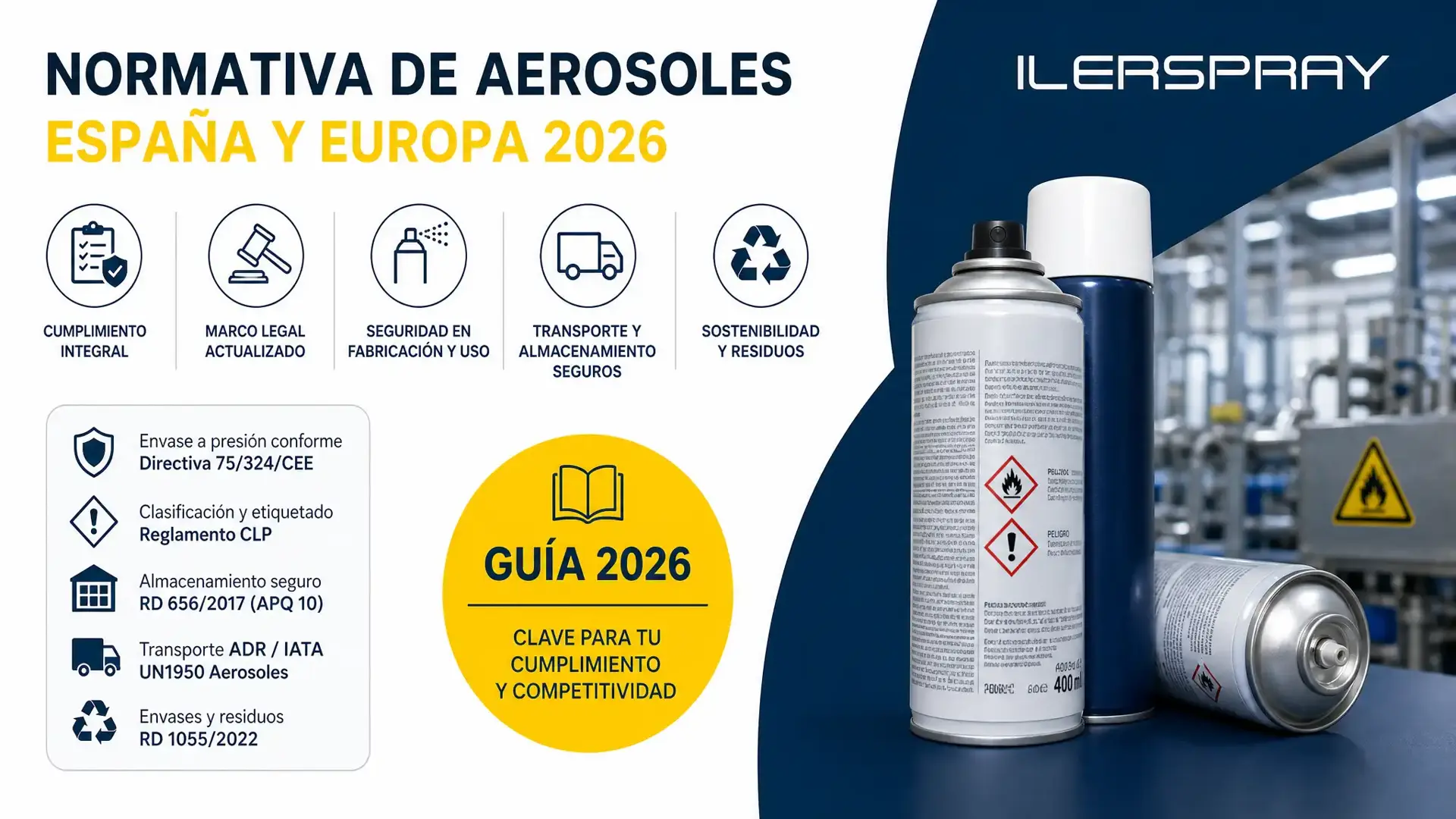
An aerosol sold in Spain has to meet five sets of rules: Royal Decree 1381/2009 for the pressurised container, the CLP Regulation for its classification and label, REACH for its safety data sheet, the APQ-10 instruction for storage and the ADR for transport. A cosmetic or a biocide also has to meet its own regulation.
Which Regulations Govern Aerosol Manufacturing?
Each rule looks at a different part of the product: the pressurised container, the mixture inside it, the warehouse where it is kept or the lorry that carries it. That is why a technically flawless aerosol can still break the law because of a misclassified label or an outdated safety data sheet.
| Rule | What it covers | What it requires in practice |
|---|---|---|
| RD 1381/2009 (Directive 75/324/EEC) | The pressurised container | Capacity, pressure, final test, marking |
| CLP Regulation (EC 1272/2008) | Classification and label | Category, pictogram, H and P statements |
| REACH Regulation (EC 1907/2006) | Information for customers | Safety data sheet |
| RD 656/2017, ITC MIE APQ-10 | Storage | Conditions by category and quantity |
| ADR | Road transport | UN 1950, class 2, package marking |
| Sector regulations | Cosmetics and biocides | Prior notification or authorisation |
The aerosol directive and the CLP and REACH regulations are European, so the same framework applies across the EU. What changes from one country to the next is the language of the label and the data sheet, and the national storage rules.
What Is Directive 75/324/EEC?
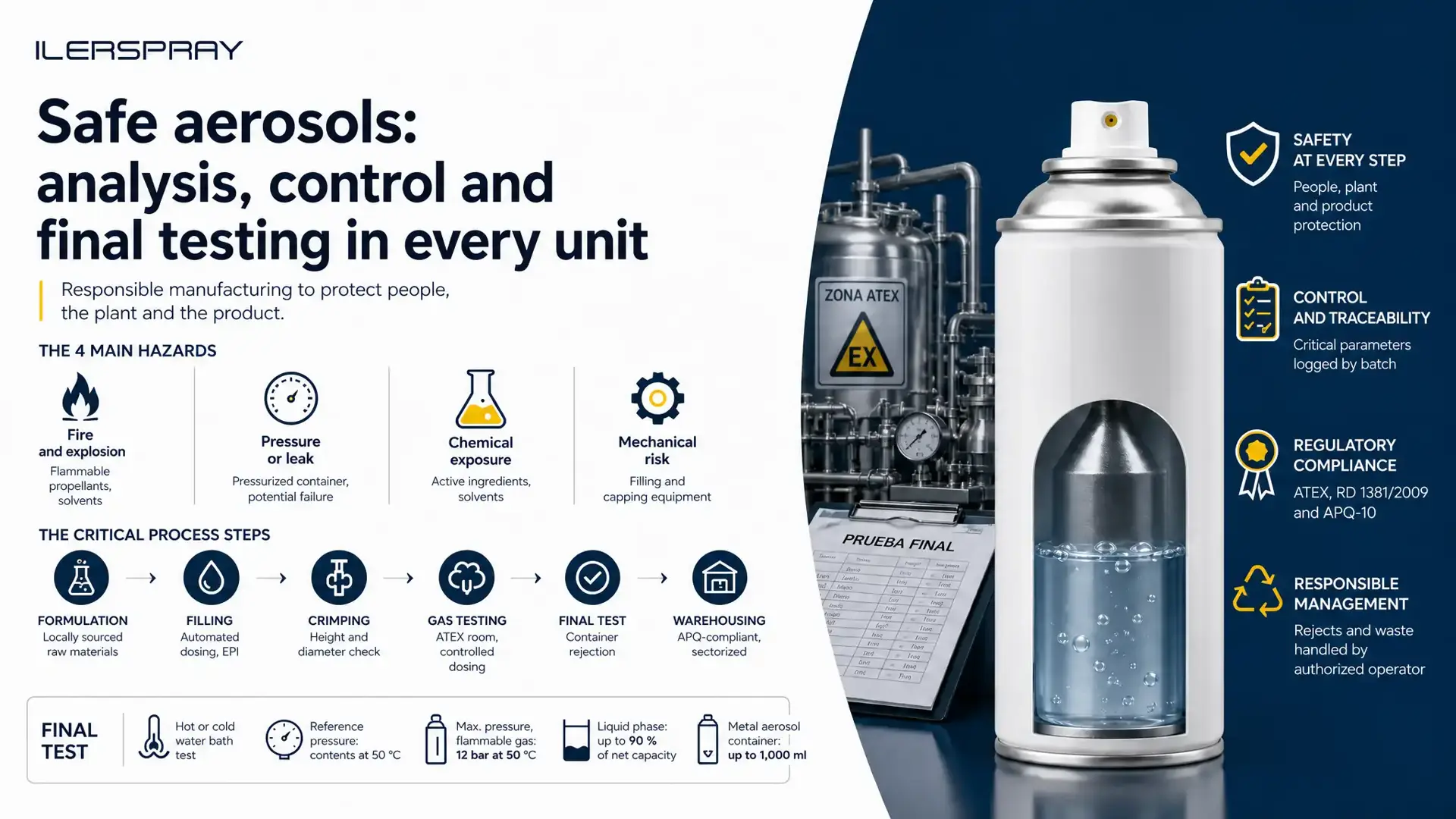
It is the European rule specific to the aerosol dispenser: a non-reusable container made of metal, glass or plastic holding a gas that is compressed, liquefied or dissolved under pressure, with a device that releases the contents. In Spain it applies through Royal Decree 1381/2009, whose text was updated in 2014 and 2017 to align the label with CLP.
Its technical requirements fit in a handful of values:
- Outside its scope
- containers under 50 ml
- Metal container
- up to 1,000 ml
- Protected glass
- up to 220 ml
- Unprotected glass
- up to 150 ml
- Liquid phase at 50 ºC
- at most 90 % of capacity
- Final test
- every filled unit
The final test is not a sample check. Every filled aerosol goes through a hot water bath that brings its internal pressure to the level it would reach at 50 ºC, or through an alternative method authorised by the competent authority. Once it passes, the responsible party stamps the inverted epsilon mark on the container.
Any aerosol dispenser showing visible permanent deformation or a leak shall be rejected.
Classifying, Labelling and Documenting the Mixture
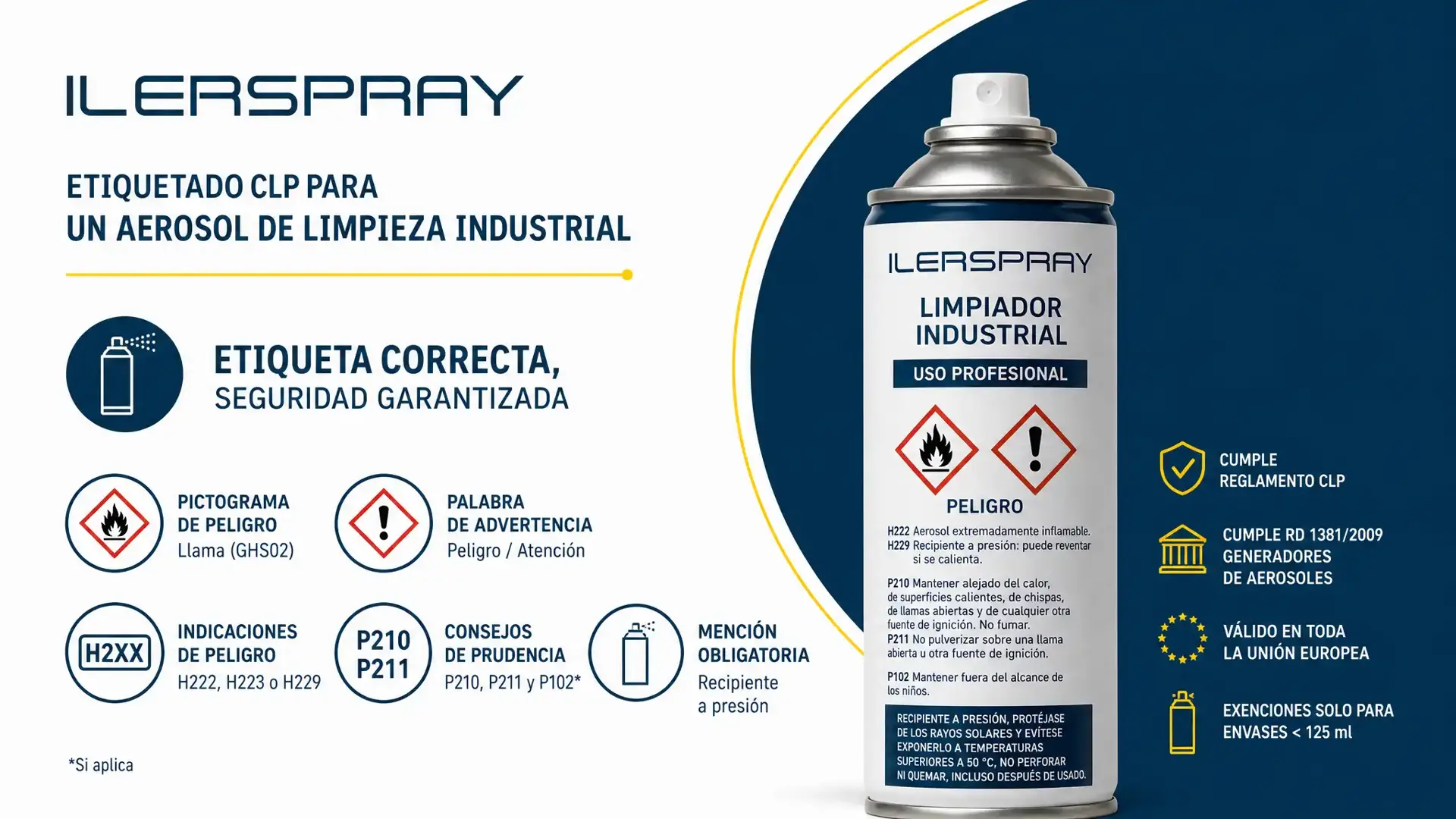
The container is only half of it. The formula and the propellant are classified under the CLP Regulation, which for an aerosol mainly decides the flammability category: 1 (extremely flammable), 2 (flammable) or 3 (non-flammable). All three carry the H229 statement, because any pressurised container may burst if heated; the category also sets the pictogram and the signal word.
That classification produces the safety data sheet. The Spanish Ministry of Health notes that REACH requires one for anything classified as hazardous, with 16 headings, free of charge, on paper or electronically and at least in Spanish. Technical and cleaning aerosols with a flammable propellant need one; finished cosmetics do not, because REACH exempts them from this obligation and their own regulation covers them.
Storing and Shipping the Finished Aerosol
Royal Decree 656/2017, which approves Spain's Regulation on the Storage of Chemical Products, expressly assigns aerosols to its technical instruction MIE APQ-10, the one on storage in mobile containers. Warehouse conditions depend on the CLP category of the aerosols and the quantity stored, so a classification error also leads to a poorly planned warehouse.
By road, aerosols travel as UN 1950 AEROSOLS, ADR class 2. Most shipments use the limited quantities regime, which simplifies marking and paperwork without removing the obligations, while air freight is considerably more restrictive. Section 14 of the safety data sheet must match what is actually shipped.
What Obligations Does a Brand Owner Have?
Whoever puts their brand on an aerosol is the person responsible for placing it on the market, even without a factory: their name and address go on the label, the aerosol is sold under their responsibility and they are the one who supplies the safety data sheet to customers. Outsourcing manufacture moves the technical work, not the legal responsibility.
Before selling, the brand must be able to show four things:
- that the formula is classified under CLP and the classification is documented;
- that the label carries its details, the correct category and the statements required by Royal Decree 1381/2009, at least in Spanish for Spain;
- that the safety data sheet exists, matches the label and is updated whenever the formula changes;
- that, if the product is a cosmetic or a biocide, it has its notification or authorisation before it reaches the market.
💡 Technical tip: ask for the CLP classification in writing before printing the label. A change of propellant or solvent can move the aerosol into another category and force you to reprint the whole batch of labels.
In contract manufacturing, the manufacturer prepares that work: at Ilerspray, the validation and regulatory stage covers technical sheets, safety data sheets and regulatory registration where required, before production starts. The full process, from brief to pallet, is on the aerosol contract manufacturing page.