An Aerosol Safety Data Sheet Has 16 Sections
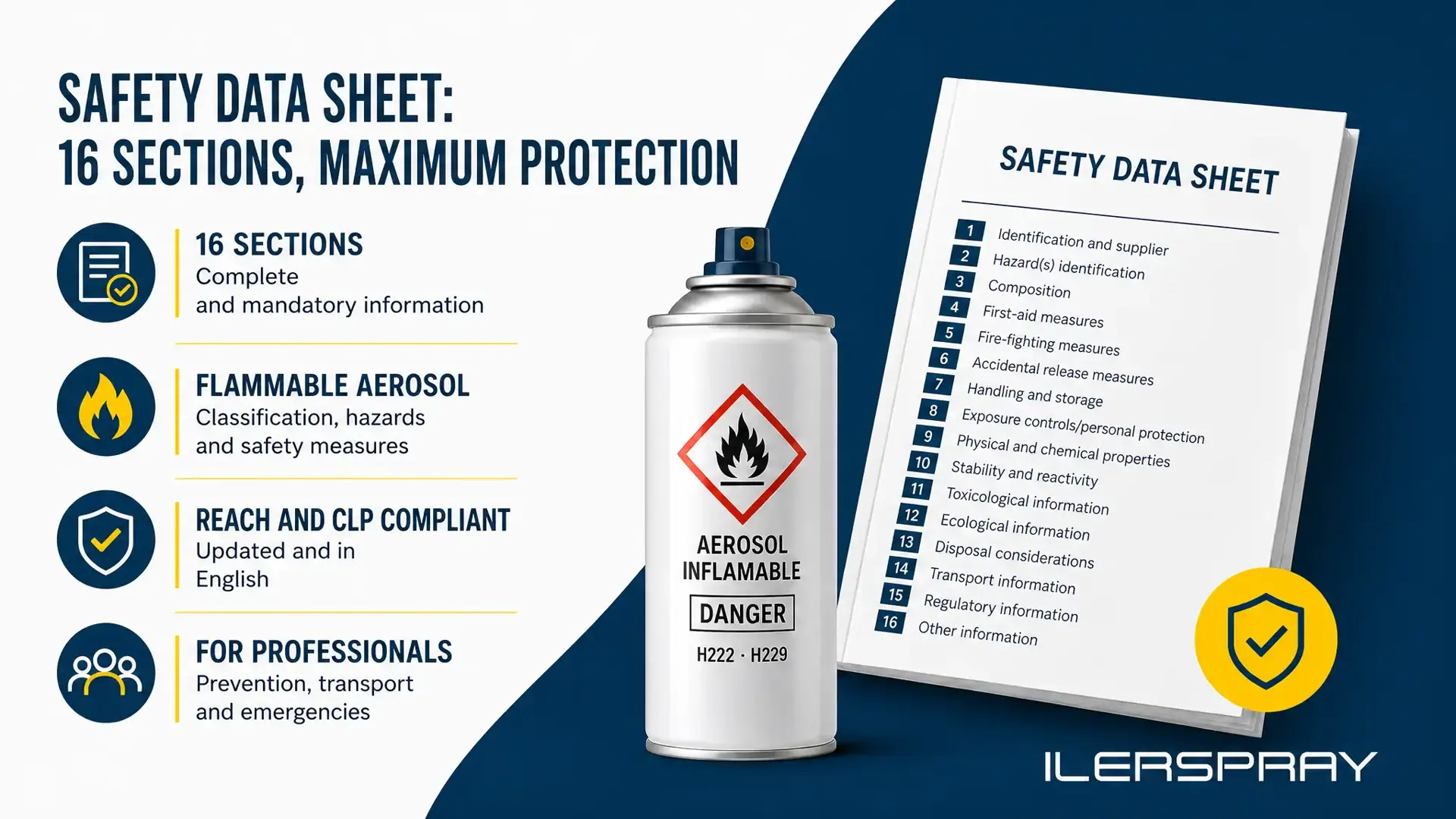
A safety data sheet (SDS) is the 16-section document that the REACH Regulation requires for any substance or mixture classified as hazardous: it identifies the product and its supplier, describes its hazards and explains how to handle, store and transport it and what to do after an accident. An aerosol with a flammable propellant needs one, free of charge and in the local language, from the first delivery.
When Is a Safety Data Sheet Mandatory for an Aerosol?
According to the Spanish Ministry of Health, the supplier must provide the sheet when the product is classified as hazardous under CLP, when it is persistent, bioaccumulative and toxic, or when it contains a substance on the candidate list for authorisation. Since almost every aerosol with a hydrocarbon or DME propellant is classified as a flammable aerosol, the data sheet is the rule rather than the exception.
The INSST technical note NTP 1198 sets out the borderline cases:
| Situation | SDS required? |
|---|---|
| Mixture classified as hazardous | Yes, with the first delivery |
| Not classified, with ≥1 % hazardous substance | Only if a professional customer asks |
| Not classified, gaseous mixture | On request, from ≥0.2 % by volume |
| Sold to the public with enough information | No, unless a professional asks |
| Finished cosmetic | No, covered by its own regulation |
A spray deodorant needing no SDS under REACH does not mean it travels without paperwork: the carrier and the warehouse still need its classification for transport and storage.
What to check in each section of a safety data sheet
The content is set by Annex II of REACH, replaced by Regulation (EU) 2020/878, mandatory for every data sheet since 1 January 2023. There are 16 fixed sections and no heading may be left blank; the length of the sheet is proportionate to the hazard of the product.
| Section | Content | What you check on your aerosol's sheet |
|---|---|---|
| 1 | Identification and supplier | That it names your brand, the supplier and an emergency phone number |
| 2 | Hazards identification | That the aerosol category and the H222 or H223 and H229 statements match the label |
| 3 | Composition | That the hazardous components are listed, propellant included |
| 4 | First aid | That it covers inhalation and skin and eye contact |
| 5 | Firefighting | That it warns of the can bursting when heated |
| 6 | Accidental release | That it covers leaks, ventilation and ignition sources |
| 7 | Handling and storage | That it says to keep it out of the sun, below 50 ºC |
| 8 | Exposure controls | That it gives exposure limits and protection |
| 9 | Physical and chemical properties | That it states the % by mass of flammable components |
| 10 | Stability and reactivity | That it names heat and incompatible materials |
| 11 | Toxicological information | That it describes the effects of your formula |
| 12 | Ecological information | That it covers effects on the aquatic environment |
| 13 | Disposal | That it covers containers with residual pressure |
| 14 | Transport | That it says UN 1950, class 2, like the shipping case |
| 15 | Regulatory information | That it cites the rules that apply to the product |
| 16 | Other information | That it carries the revision date and the changes |
Who uses the data sheet, and what to check because of it
The data sheet is the risk assessment tool of whoever receives the product. Annex II itself requires it:
In particular, the safety data sheet shall enable employers to determine whether any hazardous chemical agents are present in the workplace and to assess any risk to the health and safety of workers arising from their use.
In practice it is read by the customer's health and safety officer, the warehouse (section 7), the carrier (section 14) and the emergency services (sections 4 to 6). That is why the butane or propane data sheet supplied by the gas vendor will not do: it describes only the propellant, while the aerosol's sheet must cover the whole mixture, formula and propellant together, in its pressurised container.
The check is quick: open section 3 of the sheet you were given. If only the gas appears, it is the propellant supplier's sheet and you need to ask for the aerosol's. If the formula and the propellant both appear, send it with the first delivery to your warehouse, your carrier and every professional customer.
Who Writes the Data Sheet in Contract Manufacturing?
The obligation lies with the supplier placing the aerosol on the market, usually the brand, whose details appear in section 1. Annex II requires it to be written by a competent person with suitable training, and REACH requires it to be updated without delay when new information on hazards or risk management measures becomes available. The revised version carries the mention "Revision: (date)" and is sent free of charge to every customer who received the product in the previous 12 months.
In practice, the data sheet is prepared by whoever knows the formula. In Ilerspray's contract manufacturing it is part of the validation and regulatory stage, together with technical sheets and regulatory registration where required, and it is delivered with the product.
The data sheet comes in English to start with; if you are a repeat customer and need it in the language of a country where you sell, we look into the translation. REACH does require the data sheet in the official language of each country where the product is sold (Article 31).
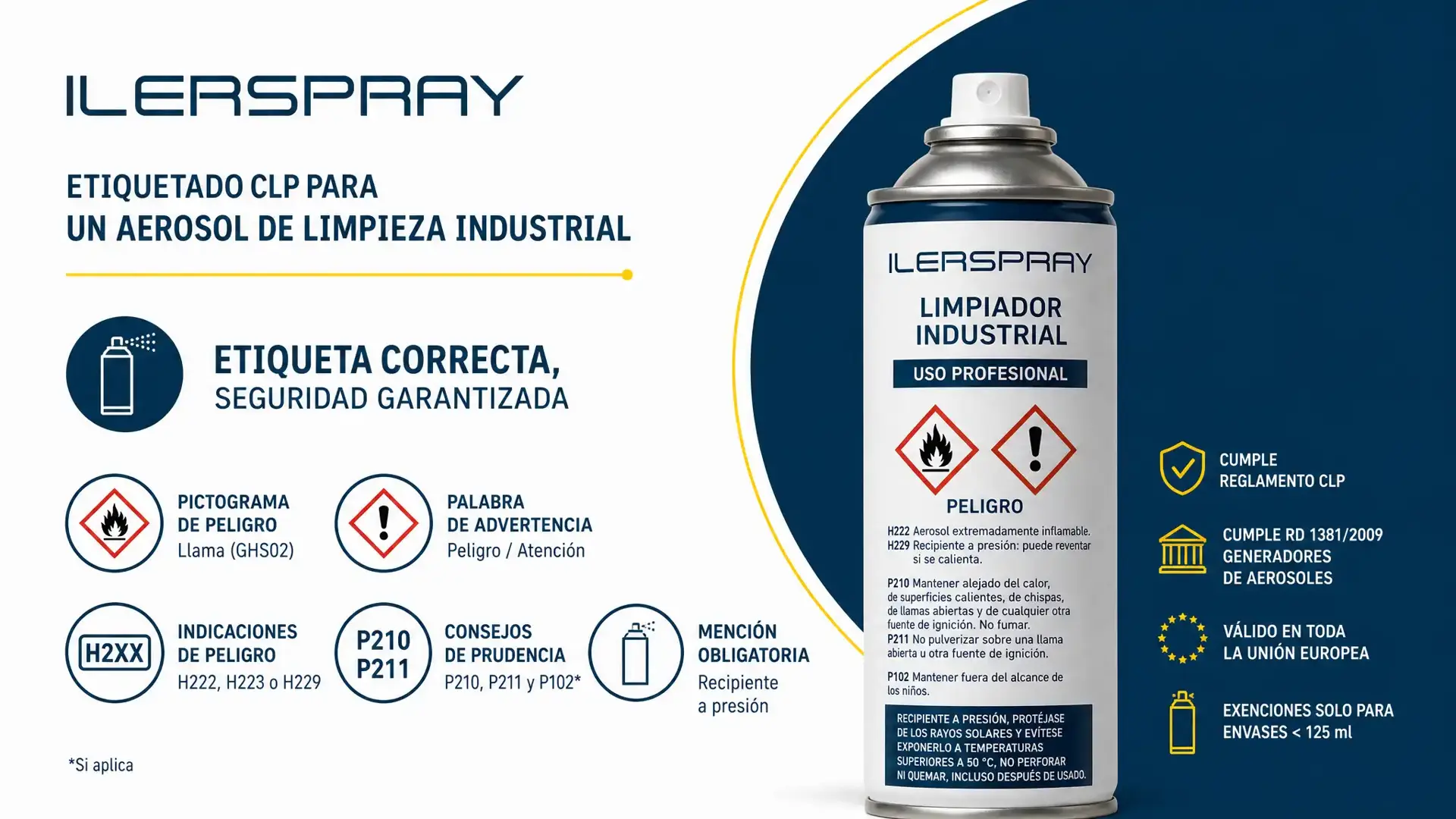
💡 Technical tip: before approving the data sheet, compare its section 2 with the label. If the category, the H statements or the pictogram do not match, one of the two documents is wrong, and any inspection or customer audit will spot it first.
Make that comparison before the first batch: in our aerosol contract manufacturing the data sheet is closed at the validation stage, before production, while a mismatch can still be fixed without reprinting anything.