Bag-on-Valve Keeps the Product Apart from the Gas That Drives It
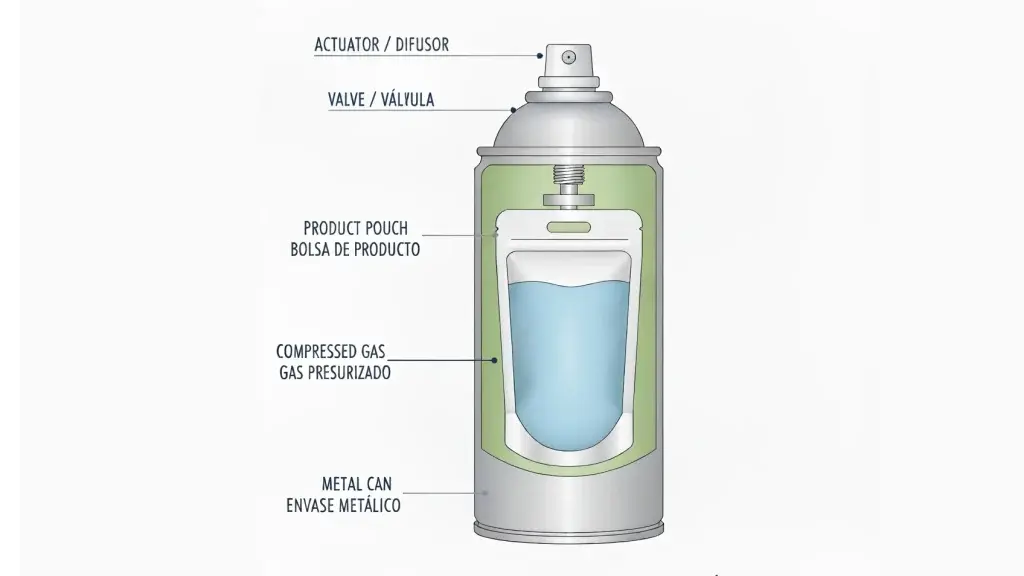
Bag-on-valve (BOV) is an aerosol system in which the product sits inside a laminated bag welded to the valve, while the gas, compressed air or nitrogen, fills the space between the bag and the can. When you press, the gas squeezes the bag and the product comes out pure, never mixing with the propellant. It suits sensitive formulas, water-based ones and products that must be non-flammable.
What Is a Bag-on-Valve System and How Does It Work?
In a conventional aerosol the propellant and the formula share the can: the liquefied gas mixes with the product and comes out with it. A BOV has two compartments. Inside the bag there is only the product; outside it, the pressurising gas, which is not part of the formula and does not come out when you press.
- Bag
- multilayer laminate, aluminium and polymers
- Valve
- welded to the bag
- Can
- metal, usually aluminium
- Gas
- compressed air or nitrogen
Filling runs in the reverse order of a classic aerosol. First the valve, with the bag already welded to it, is placed in the can; then the gas is injected between the bag and the can and the valve is crimped; only then is the product filled through the stem, straight into the bag. Finally the actuator is fitted.
Because the gas is compressed rather than liquefied, the pressure drops as the bag empties. For a metal aerosol with a non-flammable compressed gas, the EU Aerosol Dispensers Directive 75/324/EEC sets a maximum of 15 bar at 50 °C, against 12 bar for a flammable liquefied gas.
The Benefits of Keeping Product and Gas Apart
Full separation of product and propellant is the basis for every other benefit:
- It works in any position, even upside down, because the gas presses on the bag equally from every angle.
- The bag empties almost completely and leaves very little product unused.
- The formula never touches air or gas, which protects its stability and can reduce the need for preservatives.
- The spray is even and does not chill the skin, because no liquefied gas comes out and evaporates.
- With air or nitrogen, the propellant is neither flammable nor a source of volatile organic compounds.
💡 Technical tip: test the formula with the chosen BOV valve before scaling up to production. Very viscous products have a practical limit on what can pass through the stem.
Which Products Are Packed in BOV?
BOV fits wherever the priority is formula purity and stability against air:
| Sector | Typical products |
|---|---|
| Cosmetics | Face mists, sun protection, shaving gels |
| Pharmacy | Saline solutions, burn gels |
| Food | Spray oils and dressings |
| Household | Air fresheners and cleaners |
| Industry | Lubricants and maintenance products |
The common thread is a formula that must not come into contact with the propellant, or a product that has to work in any position.
When Bag-on-Valve Is Not the Right Choice
BOV does not suit everything. Products that need the gas to leave with the formula lose their function without it: a dry shampoo uses the push of the gas to spread the powder, and a voluminous foam forms when the liquefied propellant expands on the way out.
Nor does it suit very high viscosity formulas, which hit the flow limit of the stem. And a BOV valve costs considerably more than a conventional valve, so the system is mainly kept for products where separation adds value the end customer will pay for.
Is Bag-on-Valve More Sustainable?
On several counts, yes. Using air or nitrogen removes hydrocarbons from the propellant, and with them their flammability and volatile organic compounds; and since the bag empties almost fully, less product is wasted.
The can follows the same path as any metal aerosol. The FEA points out that aerosol cans are generally made of steel or aluminium, recyclable materials with market demand, and argues for including empty aerosols in packaging collection schemes. The multilayer bag, by contrast, is a composite material that stays inside the can and cannot be separated by the consumer.
Recycling is FEA's preferred route to recover the value of used (i.e. empty) aerosols.
Ilerspray does not fill bag-on-valve yet: we are studying which gases we will be able to work with in this technology. If your product calls for it, tell us; it helps steer that study. The aerosol contract manufacturing page shows the available formats and lets you send us your project so we can study which system suits it.