How Do Aerosol Propellants Work?
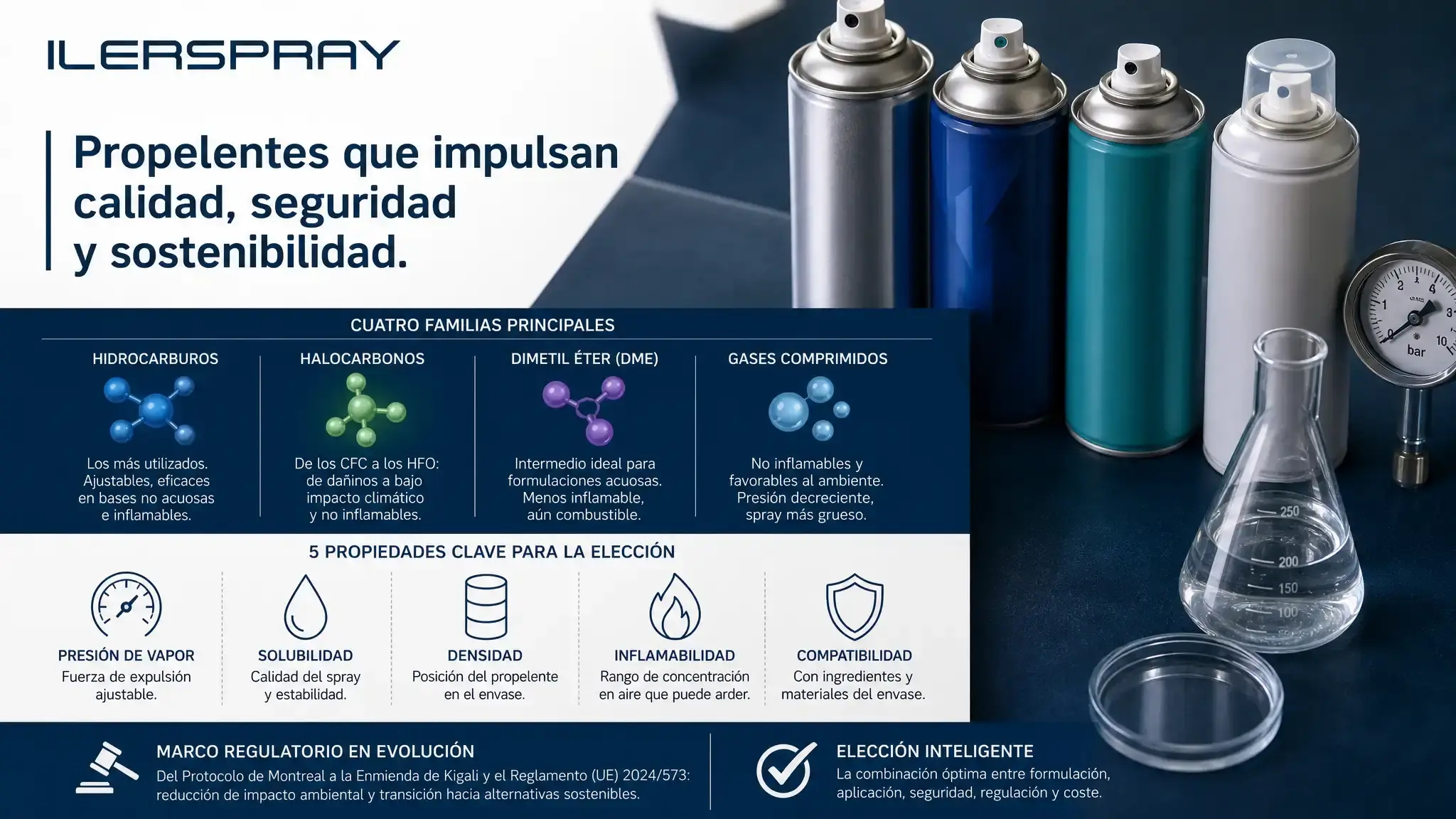
The propellant is the component that generates pressure inside the aerosol container and determines whether the product is dispensed as a fine spray, foam, gel, or powder. There are four main families: hydrocarbons, halocarbons, ethers, and compressed gases. The right choice depends on the type of formulation, the desired application, safety requirements, and the current regulatory framework.
The Four Families of Propellants
Hydrocarbons (propane, butane, and isobutane) are the most widely used propellants in the industry today. They are odorless, colorless, and flammable, and their vapor pressure can be adjusted by mixing several of them in different proportions. They have good solubility with oily products, making them especially suitable for non-aqueous formulations.
Halocarbons group fluorinated gases together. Classic CFCs were banned internationally due to their destructive effect on the ozone layer. Their successors, HFCs (hydrofluorocarbons), do not damage the ozone but have a high global warming potential, so their use is also being restricted. The most recent generation, HFOs (hydrofluoroolefins), combines the non-flammability characteristic of this family with a significantly lower climate impact.
Dimethyl ether (DME) occupies a middle ground: it is partially soluble in water, which allows for the formulation of water-based products, and it is less flammable than pure hydrocarbons, although it remains a combustible propellant.
Finally, compressed gases (nitrogen, carbon dioxide, compressed air) always remain in a gaseous phase inside the container. They are non-flammable and offer a favorable environmental profile, but the pressure decreases progressively as the product is consumed, and the resulting spray is usually coarser and less fine than that of liquefied gases.
Technical Properties Governing Selection
Propellant selection is based on five parameters that must be evaluated together:
| Parameter | What it determines |
|---|---|
| Vapor pressure | The expulsion force of the product (measured in bars or psi). It can be adjusted by mixing propellants. |
| Solubility | The spray quality, emulsion stability, and aerosol behavior. |
| Density | The position of the propellant inside the container: denser ones settle at the bottom; less dense ones at the top. |
| Flammability | The lower and upper flammability limits define the concentration range in air where the mixture can burn. Propane, for example, is flammable between 2.4% and 9.5% concentration in air. |
| Compatibility | The ability of the propellant to coexist without adverse reactions with the product ingredients and the container materials. |
💡 Formulator's insight: when no single propellant meets all requirements, mixtures are used. Combining propane and isobutane in different proportions is the standard way to obtain an intermediate vapor pressure without sacrificing solubility or safety.
The Regulatory Framework Conditioning Their Use
The regulatory environment has transformed propellant selection in recent decades. The Montreal Protocol, agreed upon in 1987, established the phase-out of CFCs after their ability to destroy the stratospheric ozone layer was demonstrated. Today, CFCs are banned in virtually all applications, with very limited exceptions for medicinal products with no proven alternative.
HFCs, introduced as ozone-safe substitutes, turned out to be potent greenhouse gases. The Kigali Amendment to the Montreal Protocol, in effect since 2019, mandates a phased reduction in their production and consumption with the goal of avoiding up to 0.4 °C of global warming by the end of the century. In the European Union, Regulation (EU) 2024/573 on fluorinated gases, in force since March 2024, further tightens the HFC reduction schedule and accelerates the transition to lower climate impact alternatives such as HFOs.
The practical result for aerosol manufacturers is that environmental and regulatory criteria now carry as much weight in propellant selection as technical or economic criteria.
How Is the Propellant Loaded into the Container?
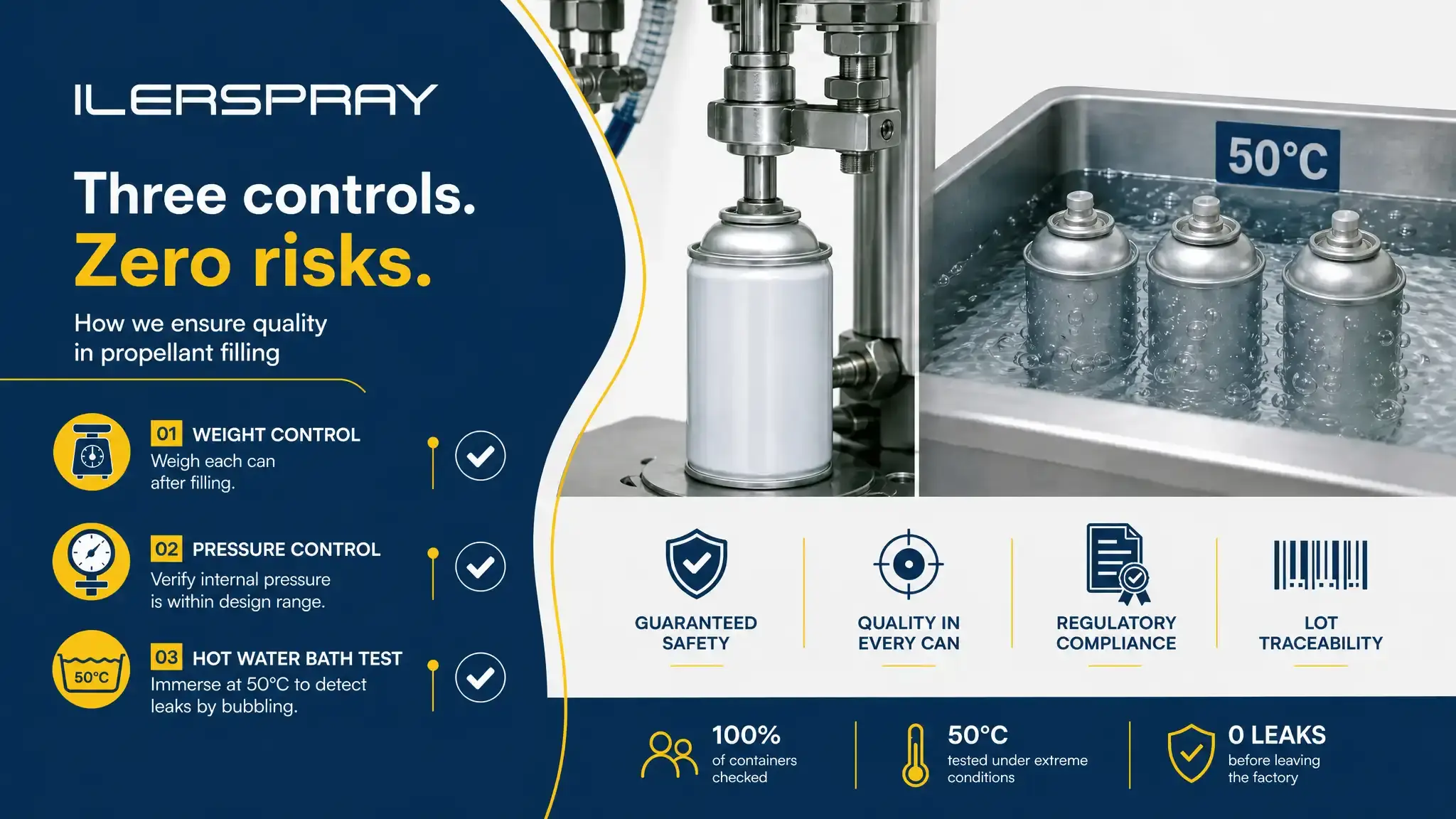
The propellant is added to the aerosol at a specific stage of the manufacturing process, after the product (the active ingredients) has already been loaded into the empty container and the valve has been installed and sealed. The propellant is injected through the valve itself, followed by a weight check and a hot water bath at 50 °C to detect potential leaks before the product reaches the market. This sequence is important because it ensures container integrity and precise propellant dosing.
What Factors Determine the Final Choice?
The decision always combines several simultaneous criteria:
- The type of formulation (water-based or oil-based) dictates the necessary solubility and rules out certain propellants.
- The desired application method (fine spray, dense foam, gel) requires different vapor pressures.
- The safety requirements of the end use set the acceptable flammability limit.
- The regulatory framework of the target market determines which propellants are legally and commercially viable.
- The cost varies significantly between families: HFOs, for example, are notably more expensive than conventional hydrocarbons.
In practice, most aerosol formulations are handled using hydrocarbon mixtures or DME for water-based products, reserving HFOs for applications where non-flammability is essential and fluorinated gas regulations limit the use of HFCs.